Comparing methods
Ferber vs cry it out vs the chair method: which is right for your family
How the Ferber method, cry it out and the chair method really differ, what each asks of you at 2 a.m., what the research says, and how to choose.
If you have searched for sleep-training advice, you have probably found two camps shouting past each other. One says any crying is harmful. The other says just close the door. Most parents are somewhere in the middle, tired, and trying to work out what they can actually live with.
This is a plain comparison of the three approaches parents ask about most: the Ferber method, cry it out and the chair method. We make an app for the Ferber method, so read this knowing that. We have tried to be fair, because the right method is the one your family can follow consistently, and that is not the same for everyone.
The short version
- Cry it out: put your baby down awake and do not go back in until morning. Usually the most crying at first, often the fastest change, and strong research support. Hard for many parents to bear.
- The Ferber method: put your baby down awake and check in briefly at intervals that grow longer. Some crying alone between visits, often noticeable change within a week, well studied.
- The chair method: sit by the crib until your baby sleeps, then move farther away every few nights. Usually less crying alone on any given night, but slower, and you are in the room at every sleep for weeks.
All three share the same starting point. Your baby goes into the crib awake after a calm routine, so they can learn to do the last part of falling asleep themselves. For the full table, including pick up, put down and bedtime fading, see our method comparison.
Cry it out (extinction)
What you do. After your bedtime routine, you put your baby in the crib awake, say goodnight and leave. You do not go back in until a set time in the morning, except to check that they are safe or unwell. Researchers call this extinction, or unmodified extinction.
What it asks of you. The whole plan fits on a sticky note, which is its strength. The difficulty is emotional: you hear your baby cry and you have decided not to respond. If you do go in after a long stretch, your baby can learn that crying longer eventually brings you, which makes the next night harder. This approach only works if you are sure you can hold the line.
What the research says. In a review of 52 studies for the American Academy of Sleep Medicine, unmodified extinction had the strongest support of any approach, along with parent education (Mindell et al., 2006).
The Ferber method (graduated extinction)
What you do. You put your baby down awake and leave. If they cry, you wait a set time, go in for a short, calm check-in without picking them up, and leave again. The waits grow: on the classic chart, Night 1 is 3, 5 and 10 minutes, and Night 7 is 20, 25 and 30. After a night waking, you start from that night’s first wait. See the full chart.
What it asks of you. You still hear crying, and you still leave the room. But you have a plan for when to go back, and you get to see that your baby is safe. Many parents find that the check-ins are what make the method bearable. The trade-offs: some babies get more upset when a parent comes and goes, and a check-in can occasionally wake a baby who was nearly asleep. You also need to keep time accurately, which is harder than it sounds at 2 a.m.
What the research says. The same review found support for graduated extinction. In a randomized trial of babies aged 6 to 16 months, graduated extinction reduced the time babies took to fall asleep and the number of night wakings, and infant stress hormone levels declined slightly rather than rising (Gradisar et al., 2016). An earlier trial of a graduated approach called controlled crying found more sleep problems resolved at two months, and mothers’ depression scores improved (Hiscock and Wake, 2002).
The chair method (adult fading)
What you do. After the routine, you put your baby down awake and sit on a chair beside the crib, offering as little interaction as possible, until they fall asleep. Every few nights, you move the chair: halfway across the room, to the door, then just outside it. Researchers sometimes call versions of this “camping out” or “adult fading.”
What it asks of you. Time and presence. You are in the room at every bedtime and every waking, often for two weeks or more. Your baby may cry less alone, but they may still cry, now with you sitting there not picking them up, which some parents find harder than leaving. And because you are there until sleep, some babies come to need the chair itself.
What the research says. Chair-style approaches have been studied much less on their own than extinction and graduated extinction. That does not mean they do not work. It means we can say less about how well.
What about long-term effects?
This is the question underneath most arguments about sleep training, so here is what the best evidence says.
The longest follow-up tracked children from an Australian infant sleep trial until they were 6. There were no differences between families who had been taught behavioral sleep techniques and those who had not in children’s emotional or behavioral problems, stress, or closeness with their parents, or in parents’ mental health (Price et al., 2012). The researchers concluded the techniques have no marked long-lasting effects, good or bad.
A small study of 25 babies in a five-day hospital sleep program found that by day 3 of full extinction, babies had stopped showing distress at bedtime, but their cortisol, a stress hormone, stayed elevated (Middlemiss et al., 2012). It had no comparison group and studied full extinction in a hospital, not graduated extinction at home, so it raises a question rather than settling one. The 2016 randomized trial, which did have a comparison group, found infant cortisol went slightly down with graduated extinction.
The honest summary: in the studies we have, children’s long-term outcomes look the same whether or not families sleep trained, and no approach guarantees a result.
How to choose
Ask yourself these four questions, honestly.
1. How much crying can I actually tolerate? Not in theory. At 11 p.m. on Night 2. If the answer is very little, a slower approach you can sustain will beat a faster one you abandon on the second night.
2. How does my baby react to me in the room? Some babies calm when a parent is near. Others get more wound up every time a parent appears and then does not pick them up. If yours is the second kind, fewer visits may be kinder than more.
3. Can every adult follow the same plan? Whichever method you choose, agree on it together before Night 1, including what happens at 2 a.m. and who goes in.
4. How much time do we have? The chair method is a multi-week commitment. The Ferber method and cry it out are usually shorter and more intense.
And whatever you choose, the same ground rules apply: wait until your baby is at least 4 to 6 months, check with your pediatrician if you have any health or feeding concerns, pause if your baby is sick, and keep every sleep safe, on their back, in their own crib, with nothing soft in it.
It is also completely fine to choose none of these. If the way your family sleeps is working for you, there is nothing to fix.
If you choose Ferber
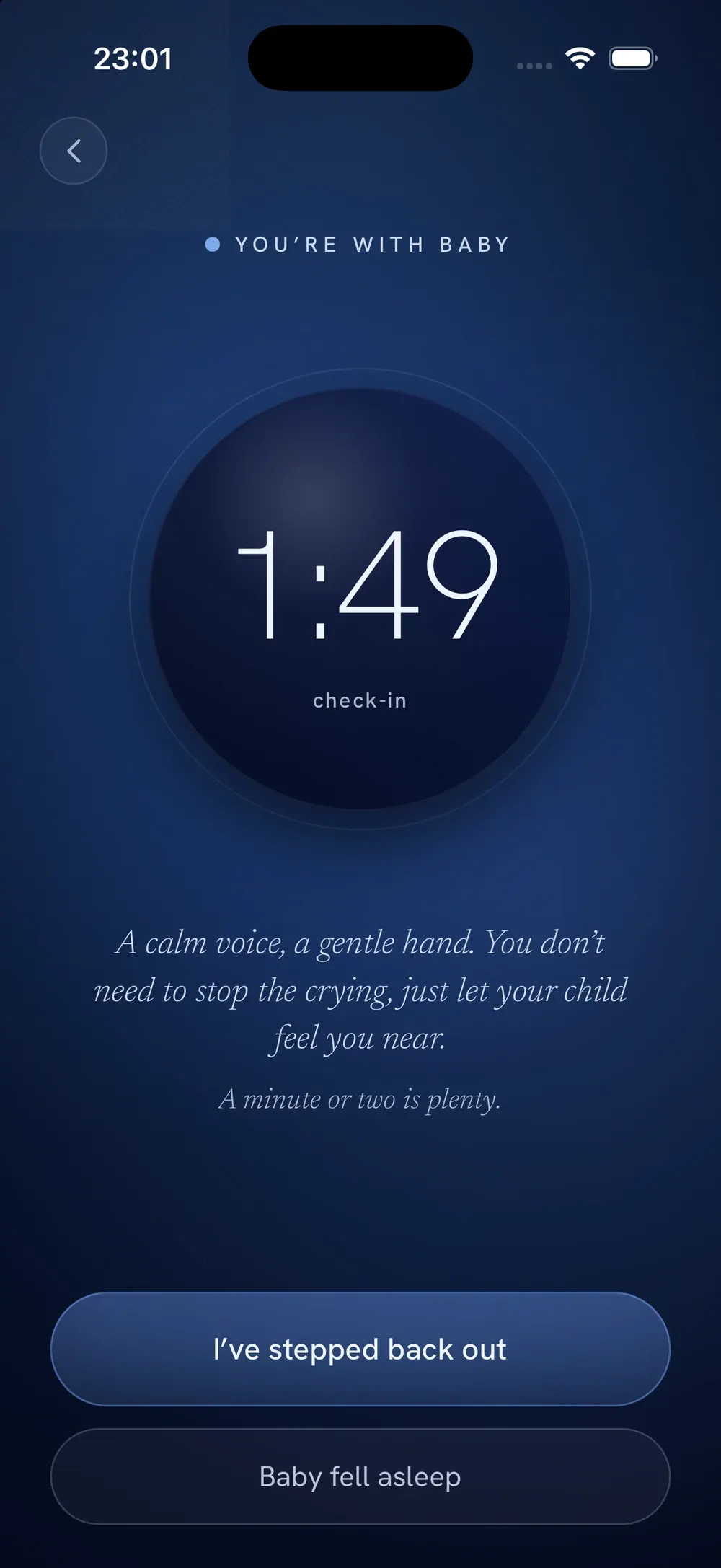
The Ferber method sits in the middle of these options: more structure and more reassurance than cry it out, faster than the chair method. Its weak point is the clock. Keeping accurate time through several waits, check-ins and wakings is hard when you are exhausted. The Ferber app was built for that: it runs each wait, alerts you at check-in time, times the check-in, and keeps a record of each night so you can see what is changing.
Common questions
Is the Ferber method gentler than cry it out?
It includes regular check-ins, which many parents find easier than not going in at all. Your baby will still cry, and on any given night the Ferber method can involve as much crying as cry it out. The difference is that you can see your baby and they can see you.
Is the chair method better for babies than Ferber?
There is no good evidence that it is better or worse for babies. It usually means less crying alone on any given night, but it takes longer and asks you to be in the room at every sleep for weeks.
Can I switch methods if one is not working?
You can, but give a method at least a week before judging it, and switch deliberately rather than night by night. Changing the plan every night is harder on a baby than any single approach.
Sources
- Mindell JA et al. Behavioral treatment of bedtime problems and night wakings in infants and young children. Sleep, 2006
- Price AMH et al. Five-year follow-up of harms and benefits of behavioral infant sleep intervention. Pediatrics, 2012
- Gradisar M et al. Behavioral interventions for infant sleep problems: a randomized controlled trial. Pediatrics, 2016
- Middlemiss W et al. Asynchrony of mother-infant HPA axis activity following extinction of infant crying responses. Early Human Development, 2012
- Hiscock H, Wake M. Randomised controlled trial of behavioural infant sleep intervention to improve infant sleep and maternal mood. BMJ, 2002
- Sleep Foundation: The Ferber Method