Intervals and check-ins
Ferber method chart: every night's intervals, and why they grow
The full Ferber method chart for all seven nights, how to read it, what to do when your baby wakes again, and why the waits get longer.
You have decided to try the Ferber method. You have read the overview, you know the idea, and now you want one thing: the numbers. How long do you wait tonight, and tomorrow, and the night after that?
Here they are, followed by how to read them, what to do in the moments the chart does not cover, and why the waits get longer. If you want the bigger picture first, start with the Ferber method, explained.
The Ferber method chart
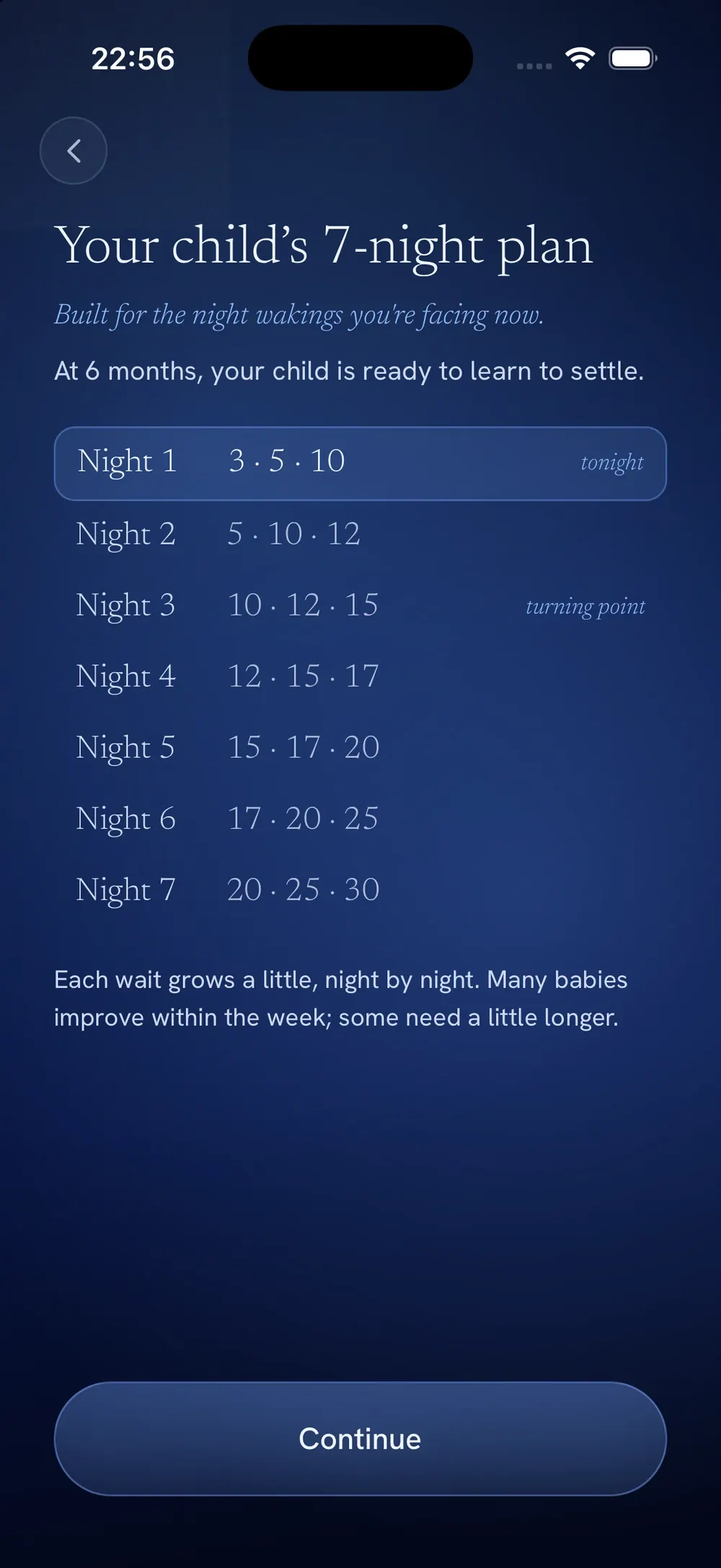
These are the intervals the Ferber app uses, drawn from the chart in Dr. Richard Ferber’s Solve Your Child’s Sleep Problems. Each row is one night. Each number is how many minutes you wait, with your baby crying, before you go in for a brief check-in.
| Night | 1st wait | 2nd wait | 3rd wait, then every wait |
|---|---|---|---|
| Night 1 | 3 min | 5 min | 10 min |
| Night 2 | 5 min | 10 min | 12 min |
| Night 3 | 10 min | 12 min | 15 min |
| Night 4 | 12 min | 15 min | 17 min |
| Night 5 | 15 min | 17 min | 20 min |
| Night 6 | 17 min | 20 min | 25 min |
| Night 7 | 20 min | 25 min | 30 min |
Waits are in minutes. After the third wait, keep repeating the third value until your baby is asleep. If your baby wakes later in the night, start again from that night's first wait.
Written out night by night:
- Night 1: 3, 5, then 10 minutes
- Night 2: 5, 10, then 12 minutes
- Night 3: 10, 12, then 15 minutes
- Night 4: 12, 15, then 17 minutes
- Night 5: 15, 17, then 20 minutes
- Night 6: 17, 20, then 25 minutes
- Night 7: 20, 25, then 30 minutes
Notice the pattern. Each night starts where the previous night’s second wait was, and the steps between waits stay small. Nothing jumps.
How to read the chart
The first number is the wait before your first check-in of the night. You have done the routine, put your baby down awake and left the room. If they cry, you start timing.
The second number is the wait after your first check-in.
The third number is the wait after your second check-in, and every check-in after that. This is the part people miss. The chart does not keep climbing through the night. On Night 1, once you reach 10 minutes, you keep waiting 10 minutes between check-ins until your baby is asleep, however long that takes.
The waits are for crying, not for silence. If your baby is fussing quietly, babbling or rolling around, you do not need to go in. If they stop crying before an interval ends, you do not go in either. If the crying starts again, begin timing that interval again.
When your baby wakes in the night
The chart applies to every waking, not just bedtime. When your baby wakes and cries after being asleep, start again from the first number for that night and build back up.
So on Night 3, a 2 a.m. waking means waiting 10 minutes before the first check-in, then 12, then 15. It does not continue from wherever you were at bedtime.
This is also the most common place for plans to slip. At 2 a.m., everyone is tired, and it is tempting to feed or rock “just this once.” If your pediatrician has said your baby still needs a night feed, keep that one feed and use the chart for the other wakings. Otherwise, treat the 2 a.m. waking exactly like bedtime. Consistency is what makes the week shorter.
Why the intervals grow
The waits get longer for two reasons.
Your baby gets more practice settling. The method only works if your baby has the chance to fall asleep without you doing it for them. Very short waits can mean a parent walks in just as a baby was about to settle, which restarts the whole thing. Gradually longer waits give your baby longer stretches to find their own way to sleep, a little more each night, without ever going from constant help to none at all.
Check-ins stop being the goal. Early in the week, a check-in reassures your baby that you have not disappeared. As the waits grow, the visits become less frequent, so they are less likely to turn into a new habit your baby needs in order to fall asleep. By Night 7, most of the work is being done by your baby.
The gradual steps are also kinder to parents. Going straight to 20 or 30 minutes on Night 1 is more than most people can bear. Starting at 3 minutes makes the first night possible.
Can you change the intervals?
Yes. The chart is a guide, not a rule, and the Sleep Foundation notes that the timing can be adjusted to what caregivers are comfortable with. If the waits feel too long, use shorter ones. What matters most is that:
- the waits get gradually longer, not shorter, through the night and the week
- every adult uses the same intervals
- check-ins stay short and calm whatever the interval
What tends to go wrong is the opposite direction: waits that shrink as the night gets harder, or a check-in that turns into rocking to sleep. Both teach your baby that crying longer brings more help.
If you have to pause
Life happens. Your baby gets a cold, a tooth comes through, you travel. If your baby is sick, stop and comfort them. Nothing about the method asks you to leave a sick baby to cry.
When everyone is well again, many families pick up at an earlier night on the chart rather than where they left off, because a few nights of extra help can bring back old habits. Use your judgment, and ask your pediatrician if you are unsure whether your baby is ready. In the Ferber app, you can change the night you are on in Settings.
What the chart cannot tell you
The chart tells you when to go in. It cannot tell you how your particular baby will respond. Some babies protest hard for two nights and then sleep; others take longer; a few are upset by check-ins and settle better with fewer visits. Research on behavioral approaches like this one is encouraging: a large review found them effective in the great majority of studies (Mindell et al., 2006), and in a randomized trial, graduated extinction shortened the time babies took to fall asleep and reduced night wakings (Gradisar et al., 2016). But studies describe groups, not your child.
Whatever the chart says, safe sleep does not change: baby on their back, on a firm, flat surface, in their own crib, with nothing soft in it.
Keeping time at 2 a.m.
The hardest part of the chart is not understanding it. It is following it precisely while exhausted, with crying in the background, trying to remember whether you are on the second wait or the third. That is what the Ferber app is for. You tap when your baby is crying and it runs tonight’s interval, tells you when to check in, restarts from the first wait after a night waking, and moves you to the next night’s numbers in the morning.
Common questions
What are the Ferber intervals for Night 1?
3 minutes before the first check-in, then 5, then 10. After that, keep waiting 10 minutes between check-ins until your baby is asleep.
Do the intervals restart when my baby wakes in the night?
Yes. When your baby wakes and cries after being asleep, start again from that night's first interval and build back up.
Can I use shorter intervals than the chart?
Yes. The chart is a guide, not a rule. If the waits feel too long for your family, shorter ones can work, as long as they still get gradually longer and you apply them the same way every time.
What happens after Night 7?
Most families no longer need a chart by then. If your baby still cries at bedtime or during wakings, keep using the Night 7 intervals of 20, 25 and 30 minutes.
Sources
- Solve Your Child's Sleep Problems, revised edition (Richard Ferber, 2006)
- Sleep Foundation: The Ferber Method
- Mindell JA et al. Behavioral treatment of bedtime problems and night wakings in infants and young children. Sleep, 2006
- Gradisar M et al. Behavioral interventions for infant sleep problems: a randomized controlled trial. Pediatrics, 2016
- American Academy of Pediatrics (HealthyChildren.org): A Parent's Guide to Safe Sleep