Setbacks and regressions
What is an extinction burst?
An extinction burst is a short-lived rise in crying when a familiar response stops. Here is what it looks like, why it happens and how to get through it.
Night 1 was hard but bearable. Then Night 2 arrives and the crying is louder, longer and angrier than anything you heard the night before. It feels like the method is going backward. Often, what you are hearing has a name.
An extinction burst is a temporary increase in a behavior right after the response that usually follows it stops. In sleep training, that means crying can get louder or longer for a night or two after you stop rocking, feeding or holding your baby to sleep, before it starts to drop. It is common, it is usually short, and on its own it is not a sign that the method has failed or that anything is wrong with your baby.
Where the term “extinction burst” comes from
The phrase comes from behavioral psychology. “Extinction” means no longer giving the response that has been keeping a habit going. The glossary entry for extinction has the short version.
Researchers noticed long ago that when a familiar response stops, the behavior that used to bring it often gets stronger for a while before it fades. A 1995 paper by Dorothea Lerman and Brian Iwata in the Journal of Applied Behavior Analysis describes the extinction burst as an initial increase in the frequency of the target behavior, and calls it the most common side effect of extinction.
An everyday version: you press an elevator button and nothing lights up. You do not walk away right then. You press it again, harder, several times, before you give up and take the stairs. The pressing got more intense for a moment precisely because the usual result stopped coming.
What it looks like during the Ferber method
For a baby used to being fed, rocked or held to sleep, crying is how they ask for that help. When the help stops arriving, crying is the obvious thing to try harder.
During the Ferber method, an extinction burst tends to look like:
- Crying that is louder or lasts longer than on Night 1
- Crying that sounds more insistent or angry
- A harder bedtime on Night 2 or 3 after a more manageable first night
- More wakings for a night, or longer stretches of crying after a waking
The Royal Australian College of General Practitioners notes that the first few nights of controlled crying are often the hardest. Our article on why Night 3 can be worse describes the pattern night by night, and how long the Ferber method takes shows what tends to come after.
The important part is that an extinction burst is about the change in the bedtime routine. During the day your baby should be their usual self: eating normally, playing, and without signs of illness.
How common are extinction bursts?
Probably less common than many parents expect. In the Lerman and Iwata review of 113 sets of extinction data from behavioral treatment, an initial increase appeared in 24 percent of cases. It was less common (12 percent) when extinction was combined with other procedures than when extinction was used alone (36 percent). The authors suggested bursting may be less common than had been assumed.
That research came from treating behavior problems, and none of it was about infant sleep, so it cannot tell you the odds for your baby. What it does suggest is that a burst is far from certain. In the Ferber method, your baby still gets timed check-ins from you throughout, which is one way it differs from full extinction.
So if your baby’s crying simply drops a little each night, nothing has gone wrong. You do not need to see a burst for the method to be working.
Extinction burst or something else?
A burst is only one possible reason for a worse night. Before you put it down to behavior, check that your baby is well.
Teething and overtiredness can also make a night worse. The guide to teething, illness and when to pause explains how to tell these apart and when to stop.
How to get through an extinction burst
The most helpful thing you can do is keep your response the same. The Sleep Foundation says the keys to the Ferber method are patience and consistency, and that a single lapse in consistency may reinforce the habit you are trying to change.
This is where a burst can backfire. If crying peaks and you pick your baby up after a very long cry, your baby learns that crying longer and harder eventually brings the old response. The next night, the crying may last even longer. Holding steady through the peak usually helps it pass sooner.
In practice:
- Decide the plan before bedtime and agree on it with anyone else doing check-ins
- Keep the waits the same. Use tonight’s numbers on the Ferber method chart, even when the crying is louder
- Keep check-ins short and calm. The Sleep Foundation suggests under one to two minutes, with a pat or soft words and no picking up or feeding
- Look at the trend. Compare how long it took your baby to fall asleep across several nights, rather than judging by the loudest moment
If you need to change the plan, for example to longer waits or a gentler method, change it before bedtime and then stick with it. The comparison page sets out the main alternatives.
Listening to a burst is hard. If the crying is overwhelming you, our page on parent anxiety has practical ideas, and stepping away for a few minutes while another adult takes over is fine.
When old crying comes back later
Sometimes the crying returns weeks after sleep has settled. The Sleep Foundation notes that children can have “post-extinction bursts,” suddenly going back to behaviors that seemed to be gone, and says this is normal.
These later bursts often show up around illness, travel, teething or a new developmental stage. Respond the way you did during training, and if needed run a few nights of the chart again. Our article on sleep regression after Ferber covers this in more detail.
If crying keeps rising after several consistent nights, or you see no improvement within about a week, the Sleep Foundation suggests talking to your pediatrician. Our checklist for when the Ferber method is not working is a good place to start.
One thing to do tonight
If tonight is Night 2 or 3, agree with your partner before bedtime that a louder night is expected and that you will both keep the same waits and the same check-ins. Write down roughly how long it takes your baby to fall asleep tonight, so tomorrow you can compare.
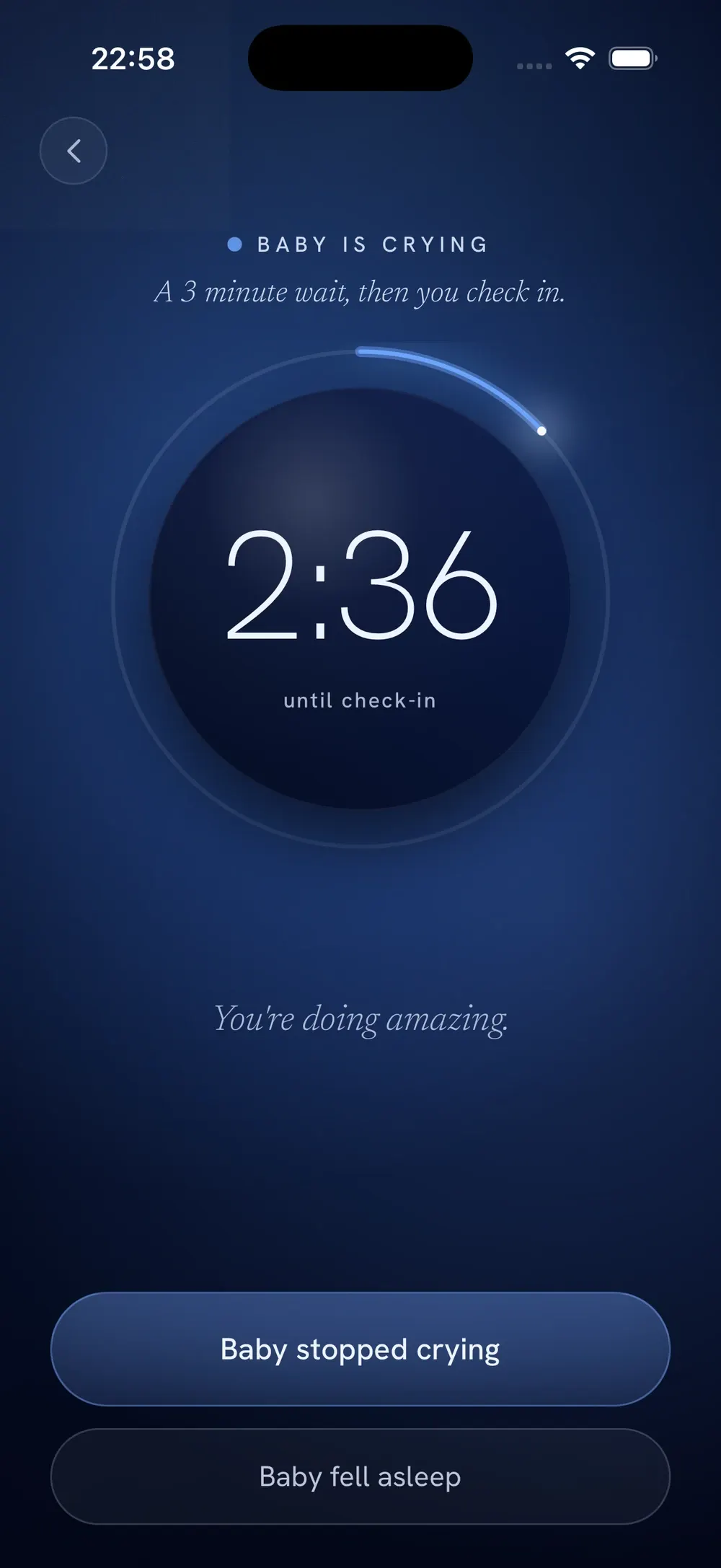
The Ferber app runs the countdown for each wait, times each check-in (2 minutes by default) and keeps a history of every night, so you can see the trend across the week rather than the hardest hour.
Common questions
What is an extinction burst in sleep training?
An extinction burst is a temporary increase in a behavior right after the response that usually follows it stops. In sleep training, it means crying can get louder or longer for a night or two after you stop rocking, feeding or holding your baby to sleep, before it starts to drop.
How long does an extinction burst last?
In sleep training it is usually short, often a night or two, and it commonly shows up on Night 2 or 3 of the Ferber method. If crying keeps rising after several consistent nights, check for illness, teething and inconsistent responses, and talk to your pediatrician if you see no improvement within about a week.
Does every baby have an extinction burst?
No. Many babies do not show an obvious burst. A 1995 review of behavioral treatment data, not about infant sleep, found an initial increase in about a quarter of cases. If your baby's crying simply drops night by night, nothing has gone wrong.
What should I do during an extinction burst?
Keep your response the same: the same routine, the same waits and the same short check-ins. Changing the plan in the middle of the burst, for example by picking your baby up after a long cry, can teach that longer crying brings the old response back.
Can an extinction burst happen weeks after sleep training?
Yes. The Sleep Foundation notes that children can have post-extinction bursts, suddenly going back to behaviors that seemed to be gone, and that this is normal. A calm, consistent response usually settles it again.
Sources
- Lerman DC, Iwata BA. Prevalence of the extinction burst and its attenuation during treatment. Journal of Applied Behavior Analysis, 1995
- Sleep Foundation: The Ferber Method
- Royal Australian College of General Practitioners: Controlled crying FAQ (2016)
- American Academy of Pediatrics (HealthyChildren.org): Getting Your Baby to Sleep
- American Academy of Pediatrics (HealthyChildren.org): When to Call the Pediatrician: Fever