The method
The Ferber method, explained: a complete guide for parents
What the Ferber method is, when a baby is ready, how each night works, what the first week feels like, and what the research says. Plain English, sourced.
It is 8:40 at night. You have been rocking for forty minutes. Your baby is finally heavy in your arms, and you begin the slow lowering into the crib that you have practiced a thousand times. Their eyes open. You start again.
If that is your evening, and then again at 11, 1:30 and 4, you are not doing anything wrong. You have a baby who has learned to fall asleep one particular way, and who needs that way back every time they surface in the night. The Ferber method is one well-studied way to change that. This guide explains what it is, how it works night by night, and how to decide whether it is right for your family.
What the Ferber method is
The Ferber method is a sleep-training approach popularized by Dr. Richard Ferber, a pediatric sleep specialist who founded the Center for Pediatric Sleep Disorders at Boston Children’s Hospital. He described it in his book Solve Your Child’s Sleep Problems, first published in 1985 and revised in 2006. Researchers call the approach graduated extinction.
In one sentence: you put your baby down awake, and if they cry, you check on them briefly at intervals that grow a little longer, both through the night and across the week.
The idea underneath it is simple. All of us wake briefly between sleep cycles, many times a night. Most of the time we roll over and drift off without remembering it. A baby who falls asleep being rocked, fed or held wakes in a crib and finds that the conditions have changed, so they call for them back. Dr. Ferber calls these conditions sleep associations. The method helps your baby build new ones they can keep all night: their own crib, their own way of settling.
Is your baby ready?
Timing matters more than technique. A few honest questions before you start:
- Age. Most families start around 6 months. Sleep training is not recommended before about 4 months, when babies still need feeds at night. If your baby was born early, count from their due date and check with your pediatrician.
- Health. Your baby should be well, feeding well and growing well. If your pediatrician has any concern about feeding, reflux or growth, or if your baby is getting over an illness, wait.
- Night feeds. Ask your pediatrician whether your baby still needs a night feed. If they do, keep that feed and use the method for the other wakings.
- The week. Avoid starting during travel, a move, a new daycare or a vaccination week. You want a stretch of ordinary days.
- The adults. Everyone who does bedtime needs to agree on the plan before Night 1. Two people doing two different things is harder on a baby than either approach alone.
And one thing never changes: safe sleep. The American Academy of Pediatrics recommends putting babies on their back, on a firm, flat surface, in their own crib or bassinet, with no pillows, bumpers or loose bedding. Every check-in happens in that safe space.
Before Night 1
Set up a short bedtime routine you can repeat every night, in the same order: perhaps bath, pajamas, feed, a book, a song, and into the crib. Keep the feed early in the routine rather than last, so your baby is not falling asleep on the breast or bottle.
The AAP suggests putting babies 4 months and older to bed drowsy but awake, so they learn to fall asleep in their own bed. That is the starting point for everything else. If your baby is asleep when they land in the crib, they wake up somewhere different from where they fell asleep, and the night gets harder.
Decide in advance what a check-in will look like, what you will say, and who will go in. Write it down. At 2 a.m. you will be glad you did.
How a night works, step by step
- Do your routine and say goodnight. Put your baby in the crib awake and leave the room.
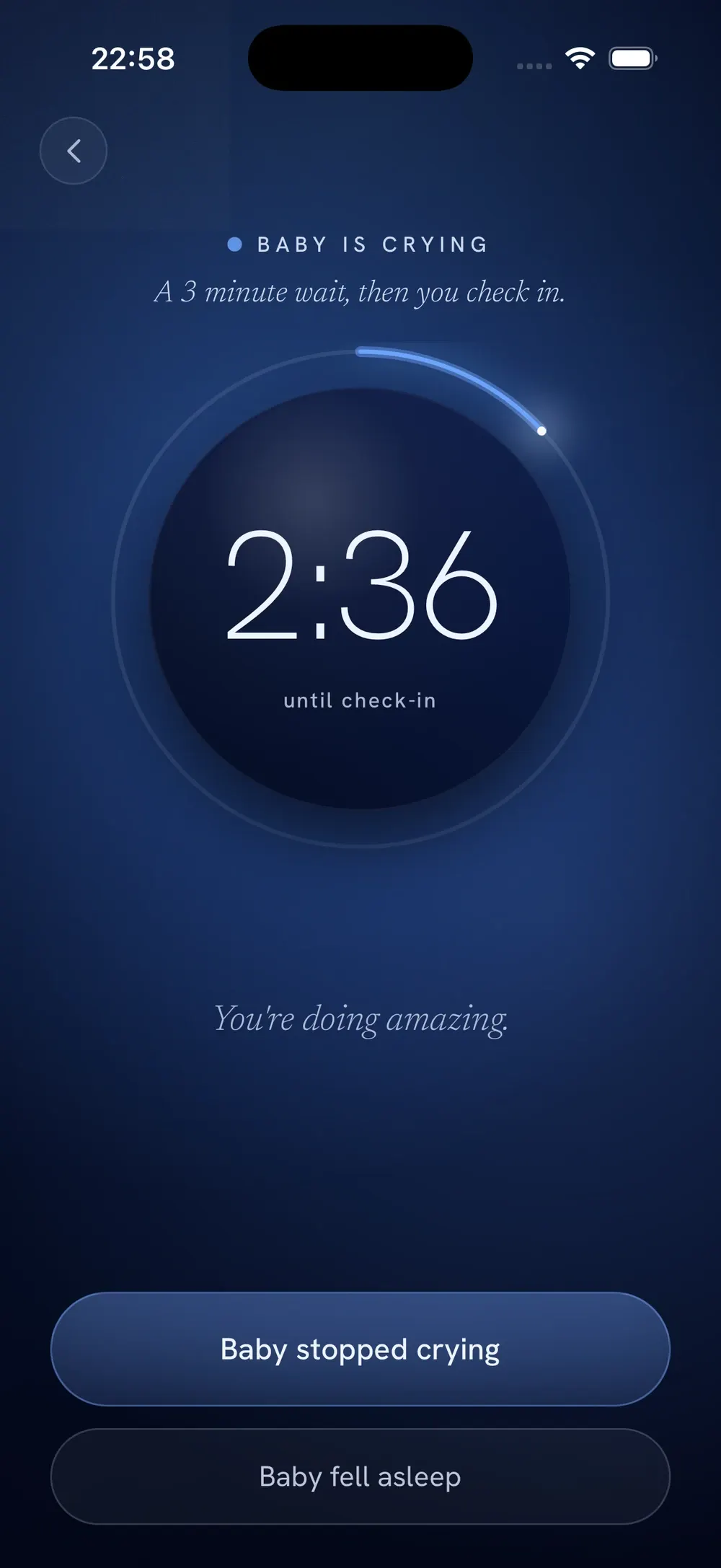
- If they cry, wait the first interval. On Night 1 of the classic chart, that is 3 minutes.
- Check in. Go in calmly, keep the lights low, use a soft voice and perhaps a pat, and do not pick them up or feed. Then leave, even if they are still crying.
- Wait the next interval. On Night 1 that is 5 minutes, then 10.
- Repeat the last interval. After the third wait, keep using the third interval (10 minutes on Night 1) until your baby is asleep.
- If they wake later in the night, start again from that night’s first wait.
- The next night, every interval is a little longer.
Here is the whole week, as the Ferber app runs it:
| Night | 1st wait | 2nd wait | 3rd wait, then every wait |
|---|---|---|---|
| Night 1 | 3 min | 5 min | 10 min |
| Night 2 | 5 min | 10 min | 12 min |
| Night 3 | 10 min | 12 min | 15 min |
| Night 4 | 12 min | 15 min | 17 min |
| Night 5 | 15 min | 17 min | 20 min |
| Night 6 | 17 min | 20 min | 25 min |
| Night 7 | 20 min | 25 min | 30 min |
Waits are in minutes. After the third wait, keep repeating the third value until your baby is asleep. If your baby wakes later in the night, start again from that night's first wait.
If your baby stops crying before an interval ends, you do not go in. If the crying starts again, you begin timing again. Our chart guide goes through the numbers in more detail, including why they grow.
What a check-in looks like
A check-in is short and a little boring on purpose. Its job is to let your baby know you are close, not to stop the crying. Many parents use the same few words every time, like “It’s okay, it’s time to sleep, I love you,” then step out.
What tends to help: a calm voice, a hand on the chest for a moment, the same words every visit. What tends to backfire: picking up, feeding, turning on the light, or staying until your baby is asleep, because your baby learns that the visit is the new way to fall asleep. The Ferber app times each check-in (two minutes by default) so the visits stay short.
What to expect across the week
Night 1 is often loud. Your baby is surprised by the change and tells you so. Many parents find the ten-minute waits are the hardest part of the whole week.
Nights 2 and 3 can be harder than Night 1. This catches a lot of parents off guard. When a response that always worked stops working, crying often gets stronger for a short time before it fades. Behavioral scientists call this an extinction burst. It is common, it is usually brief, and it is not a sign that the method is failing.
Nights 4 to 7 are when many families see real change: shorter crying, fewer check-ins, fewer wakings. Some babies are settling on their own within a few minutes by the end of the week. Others need longer, and that is normal too. No method can promise a particular night.
Keep a simple record of each night, when you put your baby down, how many check-ins, when they fell asleep. On a hard night, being able to see that Tuesday was better than Sunday is what keeps parents going.
What the research says
Graduated extinction is one of the most studied approaches to infant sleep. A review of 52 studies for the American Academy of Sleep Medicine found behavioral treatments effective in 94% of the studies, with support for graduated extinction alongside other approaches (Mindell et al., 2006).
In a randomized trial of babies aged 6 to 16 months, graduated extinction reduced how long babies took to fall asleep and how often they woke. Infant stress hormone levels declined slightly rather than rising, and a year later there were no differences in emotional or behavioral problems or attachment (Gradisar et al., 2016).
The longest follow-up tracked children from an infant sleep trial to age 6 and found that emotions, behavior, stress and the parent-child relationship were no different whether or not families had sleep trained (Price et al., 2012). Our research page covers these studies and their limits in more depth.
When the Ferber method may not fit
It is not the only way, and it is not for everyone. If hearing your baby cry alone is more than you can manage, a slower approach like the chair method may be easier to stick with, and sticking with it matters more than which plan you choose. If your family’s current sleep is working, there is nothing to fix. Our comparison of methods sets out the options side by side.
Where the app fits
You do not need an app to do this. People have used a watch and a notepad since 1985. But running the method at 2 a.m., half awake, counting minutes through crying, is exactly when mistakes happen. The Ferber app keeps the time for you: it runs each wait, alerts you when it is time to check in, times the check-in, and saves every night so you can see the week improving.
Common questions
How long does the Ferber method take to work?
Many families notice a real change within the first week, and the classic plan runs for seven nights. Some babies settle faster and some take longer. Nights 2 and 3 are often the hardest, so try not to judge the method before Night 4.
What age can you start the Ferber method?
Most families start around 6 months. Sleep training is not recommended before about 4 months, when babies still need night feeds. If your baby was born early or has a health, feeding or growth concern, talk to your pediatrician first.
Can I pick my baby up during a check-in?
The method works best if you do not. A check-in is a short, calm visit: a soft voice and perhaps a gentle hand, then out. If your baby is sick, hurt or very distressed in a way that is not ordinary protest crying, pick them up and pause for the night.
Is the Ferber method the same as cry it out?
No. Cry it out means not going in until morning. The Ferber method has you check in at set intervals that grow a little longer, so your baby knows you are near.
Sources
- Solve Your Child's Sleep Problems, revised edition (Richard Ferber, 2006)
- Mindell JA et al. Behavioral treatment of bedtime problems and night wakings in infants and young children. Sleep, 2006
- Gradisar M et al. Behavioral interventions for infant sleep problems: a randomized controlled trial. Pediatrics, 2016
- Price AMH et al. Five-year follow-up of harms and benefits of behavioral infant sleep intervention. Pediatrics, 2012
- American Academy of Pediatrics (HealthyChildren.org): Getting Your Baby to Sleep
- American Academy of Pediatrics (HealthyChildren.org): A Parent's Guide to Safe Sleep
- Sleep Foundation: The Ferber Method