Getting started
The Ferber method with twins
You can use the Ferber method with twins. Train both at once, one timer, one check-in for both, each baby in their own crib. Here is how to set it up.
One twin finally drifts off and the other starts to wail. You go in, the first one wakes up, and by midnight you have spent more time in the nursery than out of it. It is easy to assume a method built around one baby cannot work for two.
It can. The Ferber method with twins works much the same as with one baby: both go down awake at the same time, you leave, and you come back for short check-ins after gradually longer waits. The main differences are practical. Many families train both twins together, run one timer, make one check-in cover both babies, and keep each twin in their own crib.
Before you start: age and sleep space
Twins are often born early. Whether yours are ready for sleep training is a question for your pediatrician, who may go by adjusted age rather than birth date. Sleep training is not recommended before about 4 months, and 6 months is a common starting point. If your twins are younger than 6 months by the measure your pediatrician uses, talk to them first.
Each twin needs their own safe sleep space. NICHD’s Safe to Sleep guidance says bed sharing, which it defines as a baby sharing a sleep surface with an adult, another child or a pet, is not recommended. The AAP recommends avoiding bed sharing in all circumstances, including with twins and other multiples. Advice on twins sharing a crib varies between countries, and the NHS in the UK says twins can share a cot, but US guidance points to a separate crib or play yard for each baby.
The basics are the same for both cribs: on their back, on a firm, flat mattress with a fitted sheet, and nothing else inside. No pillows, blankets, bumpers or soft toys. The AAP safe sleep guide has the details.
Train both twins at the same time
It is tempting to start with the “easier” twin. In a shared room this usually backfires: the twin who has learned to settle keeps getting woken by the twin who has not, and you end up running the method twice. One plan for both, started on the same night, is simpler to keep consistent. The Sleep Foundation describes patience and consistency as the keys to the method, and two parallel plans are much harder to keep straight than one.
A shared plan looks like this:
- Same bedtime. Feed, bathe and change them in turn, but aim to have both in their cribs within a few minutes of each other.
- Same routine and words. One book read to both, the same short goodnight phrase, then out.
- One timer. Start the wait when the first twin starts crying.
- One check-in for both. When the wait ends, go in once. Say your words, give each crying twin a brief pat, and leave.
| Night | 1st wait | 2nd wait | 3rd wait, then every wait |
|---|---|---|---|
| Night 1 | 3 min | 5 min | 10 min |
| Night 2 | 5 min | 10 min | 12 min |
| Night 3 | 10 min | 12 min | 15 min |
| Night 4 | 12 min | 15 min | 17 min |
| Night 5 | 15 min | 17 min | 20 min |
| Night 6 | 17 min | 20 min | 25 min |
| Night 7 | 20 min | 25 min | 30 min |
Waits are in minutes. After the third wait, keep repeating the third value until your baby is asleep. If your baby wakes later in the night, start again from that night's first wait.
If one twin settles quickly and the other cries longer, that is common. Keep the same waits rather than giving each twin a different schedule. Many families find the slower twin catches up over the following nights. Our full guide to twins and multiples goes into staggered crying and what to do when the waits overlap.
Same room or separate rooms
Many twins share a room, and that is often fine for the Ferber method. Parents often expect the babies to keep each other up, but the NHS notes that twins often sleep through each other’s crying.
If one twin really does keep waking the other night after night, you have a few options:
- Move the cribs farther apart within the same room, so each baby is less aware of the other.
- Use separate rooms for the training week, if you have the space. This means two sets of waits and two sets of check-ins, which is more work for you. It can be worth it for a baby who is a very light sleeper.
- Accept some overlap. A twin woken by the other often settles again during the same waits.
The room sharing glossary entry covers the AAP guidance on keeping babies in your room for the first 6 months, if your twins are still in with you.
Night wakings with two babies
When one twin wakes at night and the other is asleep, respond to the crying twin the same way you did at bedtime, starting again from that night’s first wait. Keep check-ins quiet and dark so you do not wake the sleeping twin. If both are crying, one visit covers both.
Night feeds can complicate things. Whether each twin still needs a night feed is a question for your pediatrician, and the answer may differ between the two. If both still feed, the NHS suggests coordinating night feeds so that when one wakes to feed, you feed the other at the same time. For twins who no longer need feeds, any waking gets the chart. The glossary entries on dream feeds and night weaning cover the basics of planning around a kept feed.
Sharing the work between two adults
If there are two of you, decide before Night 1 who does check-ins. One calm adult per night, doing the same thing each visit, tends to be easier for babies to learn from than two people taking turns. Trade nights if you both want a turn, but not halfway through a night.
If you are on your own with twins, the plan still works. It helps to have a friend or relative you can call for the first couple of nights in case both babies need you at once, for a dirty diaper and a vomit at the same time, for example. Our guide to co-parenting and consistency has more on agreeing a plan together.
When one twin is sick
If one twin has a fever, is vomiting, seems in pain or is not feeding well, comfort them and pause the plan. Call your pediatrician if you are worried. Never leave a sick baby to cry.
A first step for tonight
Before Night 1, decide three practical things with whoever is helping: the bedtime both twins will go down at, the words you will say at check-ins, and who will do check-ins on each night. Set up the two cribs so you can see both babies from the doorway.
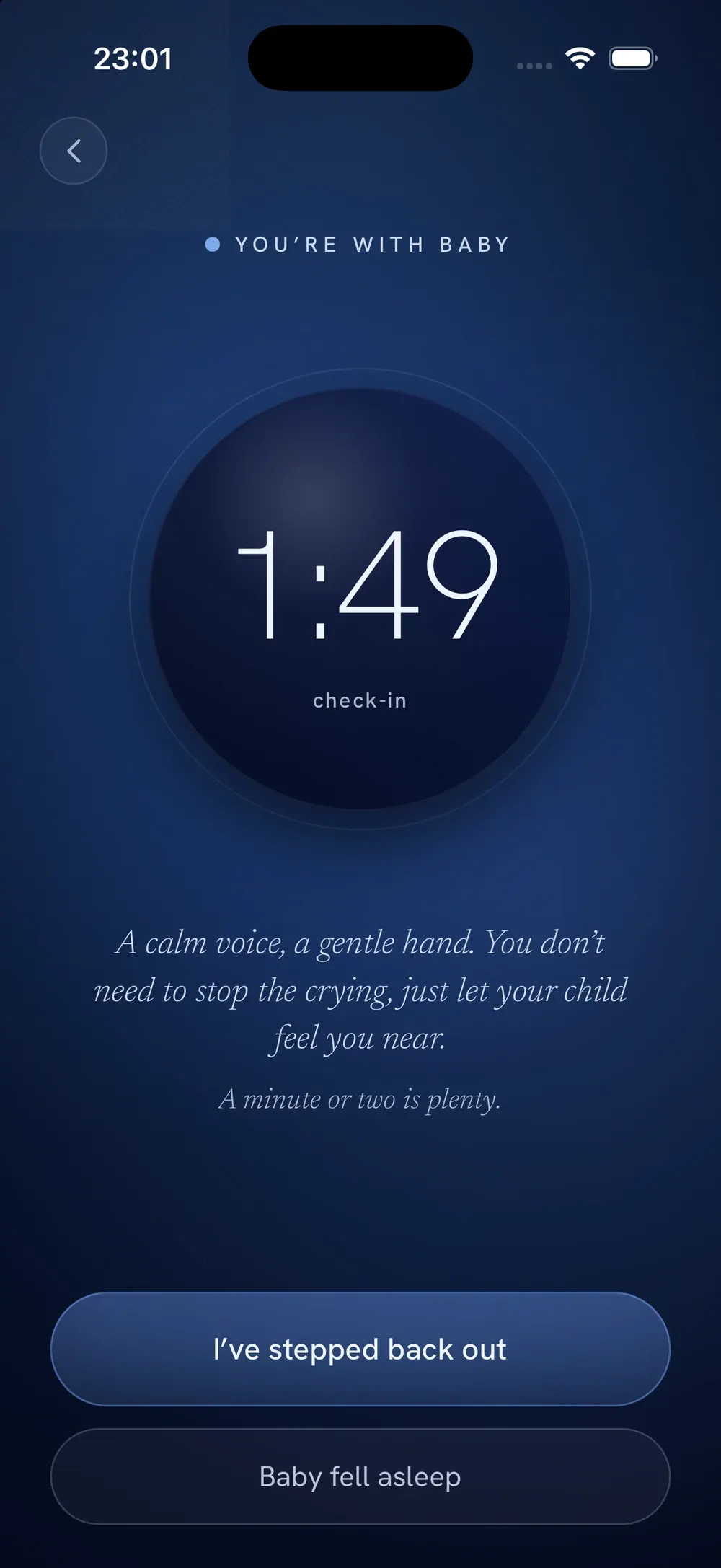
The Ferber app runs the waits and alerts you when it is time to check in, so you are not tracking a chart in your head with two babies crying. Family Sharing lets both parents use the one purchase.
Common questions
Can you do the Ferber method with twins?
Yes. Most families train both twins at the same time with one shared plan: same bedtime, same routine, one timer, and one short check-in that covers both babies. Each twin should sleep on their back in their own crib or play yard.
Should twins be sleep trained in separate rooms?
Not necessarily. Many twins share a room during the Ferber method, and the NHS notes that twins often sleep through each other's crying. Separate rooms are an option if one baby keeps waking the other, but they mean running two sets of waits.
What if only one twin wakes at night?
Respond to the twin who is crying with the same waits and check-ins you use at bedtime. Keep the visit quiet so the sleeping twin is not disturbed. If the other twin wakes too, the same check-in covers both.
When can premature twins start the Ferber method?
Twins are often born early, so ask your pediatrician, who may go by their adjusted age rather than their birth date. Sleep training is not recommended before about 4 months, and 6 months is a common starting point.