Getting started
Doing the Ferber method when you share a room
You can do the Ferber method while room sharing. How to set up the room, where to wait, and why bed sharing is never a step in the plan.
The crib is three feet from your bed. There is no nursery down the hall, or there is and your pediatrician’s advice, or your own instinct, says to keep your baby close for now. Every guide to the Ferber method says “leave the room”, and you are wondering how that works when the room is also where you sleep.
It works. The Ferber method with room sharing follows the same steps as in a separate nursery: your baby falls asleep in their own crib or bassinet, you leave the room during the waits, and you come back for short check-ins. The only real differences are how you set up the space and what happens when you go to bed yourself.
Why so many families room share
The American Academy of Pediatrics recommends that babies share their parents’ room for at least the first 6 months, sleeping close to the parents’ bed but on their own separate surface, not in the same bed (AAP, A Parent’s Guide to Safe Sleep). The AAP’s 2022 policy lists room sharing without bed sharing among its core recommendations for reducing sleep-related infant deaths (Moon et al., 2022).
Six months is also when many families start sleep training, so the two overlap all the time. After 6 months, where your baby sleeps is a family decision. Some families keep room sharing for space or preference, some share a room with a sibling, and some are waiting until a move. None of these rule out the method.
Whatever the room, the sleep space stays the same: baby on their back, on a firm, flat surface, in their own crib or bassinet, with a fitted sheet and nothing else. No pillows, blankets, bumpers or soft toys.
Setting up a shared room for the Ferber method
A few changes make the room easier for both of you.
Think about sightlines. Some babies settle better when they cannot see a parent’s bed or the doorway. If you want to block the view, use a freestanding screen, a bookcase or a curtain on the room’s own fixtures, placed well away from the crib. Never attach a divider, fabric or cover to the crib itself. The AAP advises against anything that attaches to crib slats or sides, including bumper pads, because of the risk of suffocation, entrapment or strangulation.
Keep the crib clear of cords and furniture. A curtain or screen near the crib can bring cords, gaps or a climbing route with it. Leave clear space around the crib on all sides your baby can reach.
Plan your exit. You will be leaving and coming back several times on Night 1. Know where you will wait (the hallway, the kitchen, the couch) and clear a quiet path to the door.
If you use white noise, keep it low and away from the crib. It is not required. If you do use a sound machine, a study that measured 14 infant sleep machines found all of them exceeded the noise limit recommended for hospital nurseries when played at maximum volume 30 cm away, and three were loud enough to risk hearing damage if played at that level for more than 8 hours (Hugh et al., 2014). A low setting, with the machine across the room, is the sensible choice.
Where you wait during the intervals
This is the part that matters most. During the waits on the interval chart, leave the room, just as you would with a separate nursery. Lying quietly in your own bed a few feet away does not work as a wait. Your baby can see and hear you, and for many babies that is harder than you being gone: you are right there and not coming.
So at bedtime:
- Do your routine, put your baby down drowsy but awake, say your goodnight words and walk out.
- Wait the first interval outside the room.
- Go in for a brief check-in: calm voice, perhaps a hand on the chest, no picking up or feeding. Then leave again.
- Keep going with the chart until your baby is asleep.
If you share the room with a partner, decide in advance who goes in. One calm person doing the same thing each visit is often easier on a baby than two people taking turns in the dark. Our guide to what to do during a check-in covers the words and the timing.
When you go to bed in the same room
Many families put their baby down a few hours before their own bedtime. Coming back into the room later is the moment many room-sharing parents worry about.
Some things that tend to help:
- Get ready elsewhere. Brush teeth, change and check your phone before you come in.
- Keep the light off, or use a dim night light you do not need to switch on.
- Settle in the same way every night. A predictable, quiet routine for you makes less of an event for your baby.
If your baby does wake and cry, treat it as any other night waking. Get up, leave the room and start again from that night’s first interval. It is tempting to whisper “shh” from your bed. Try not to. A voice from the dark that never arrives tends to keep a baby calling.
It is also normal for babies to stir, murmur and resettle on their own. The AAP notes that a 6-month-old may wake in the night and go back to sleep after a few minutes, and advises not rushing in to a crying baby, because babies need time to learn to fall back asleep (AAP, Getting Your Baby to Sleep). Sharing a room means you hear all of that. Not every sound needs a response.
Bed sharing is never a step in the plan
On a hard night, bringing your baby into your bed can feel like the kindest way to stop the crying. The AAP recommends avoiding bed sharing with a baby under any circumstances, and it is not part of the Ferber method at any stage.
Night feeds follow the same rule. If your pediatrician wants a feed kept, feed your baby, then put them back in their own sleep space awake. Our night feeds article covers how to run the method around one.
If your baby is under 6 months, talk to your pediatrician before you start any sleep training, and read whether the Ferber method is safe for what the research does and does not show.
Should you move rooms first?
You do not have to. If you are planning to move your baby to their own room soon anyway, many families find it simpler to make that change first, give it a few nights to feel normal, and then start the method. That way your baby is not learning two new things at once. If a move is months away, or you prefer to room share, start where you are.
Sharing with a sibling raises the same questions: the waits happen outside the room, and the check-ins stay short. The twins and multiples guide covers more on shared rooms.
One thing to try tonight
Before Night 1, stand at the crib and look at the room from your baby’s height. Note what they can see, what you might move, and where you will wait. Then walk your exit path once in the dark.
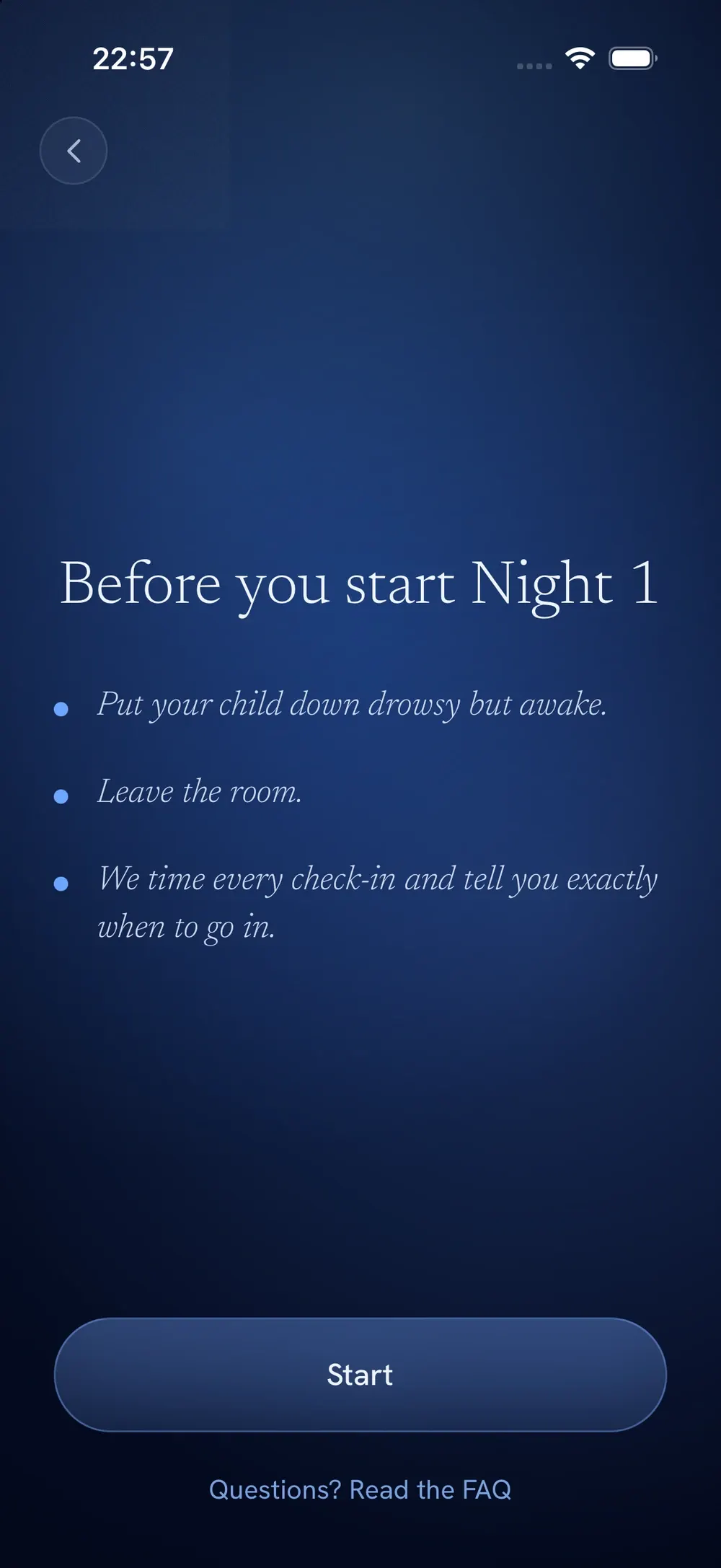
When you start, the Ferber app keeps the time for you: it runs each wait, alerts you when it is time to check in and restarts from the night’s first interval after a waking, so you can wait outside the room without watching the clock.
Common questions
Can you do the Ferber method if the baby sleeps in your room?
Yes. Put your baby down awake in their own crib or bassinet, then leave the room for the waits and come back for short check-ins, just as you would with a separate nursery. You only need to be out of sight during the waits, not all night.
Should I move my baby to their own room before starting Ferber?
The AAP recommends room sharing without bed sharing for at least the first 6 months. After that, moving rooms is a family choice. If you do both, many families find it easier to move rooms first and let the baby settle before starting the method.
Can I bring my baby into my bed if the crying goes on too long?
Bed sharing is not part of the Ferber method, and the AAP recommends against it. If you need to stop for the night, comfort your baby and settle them back in their own crib or bassinet.
What if my baby wakes when I come to bed?
Treat it like any other night waking: if they cry, leave the room and start again from that night's first interval. Getting ready for bed in the dark, quietly, and settling in the same way each night helps.
Sources
- American Academy of Pediatrics (HealthyChildren.org): A Parent's Guide to Safe Sleep
- Moon RY et al. Sleep-related infant deaths: updated 2022 recommendations for reducing infant deaths in the sleep environment. Pediatrics, 2022
- Hugh SC et al. Infant sleep machines and hazardous sound pressure levels. Pediatrics, 2014
- American Academy of Pediatrics (HealthyChildren.org): Getting Your Baby to Sleep