Intervals and check-ins
What to do (and not do) during a Ferber check-in
A practical guide to Ferber check-ins: what to say, how long to stay, why not to pick up to sleep, when to skip one, and when to stop and comfort.
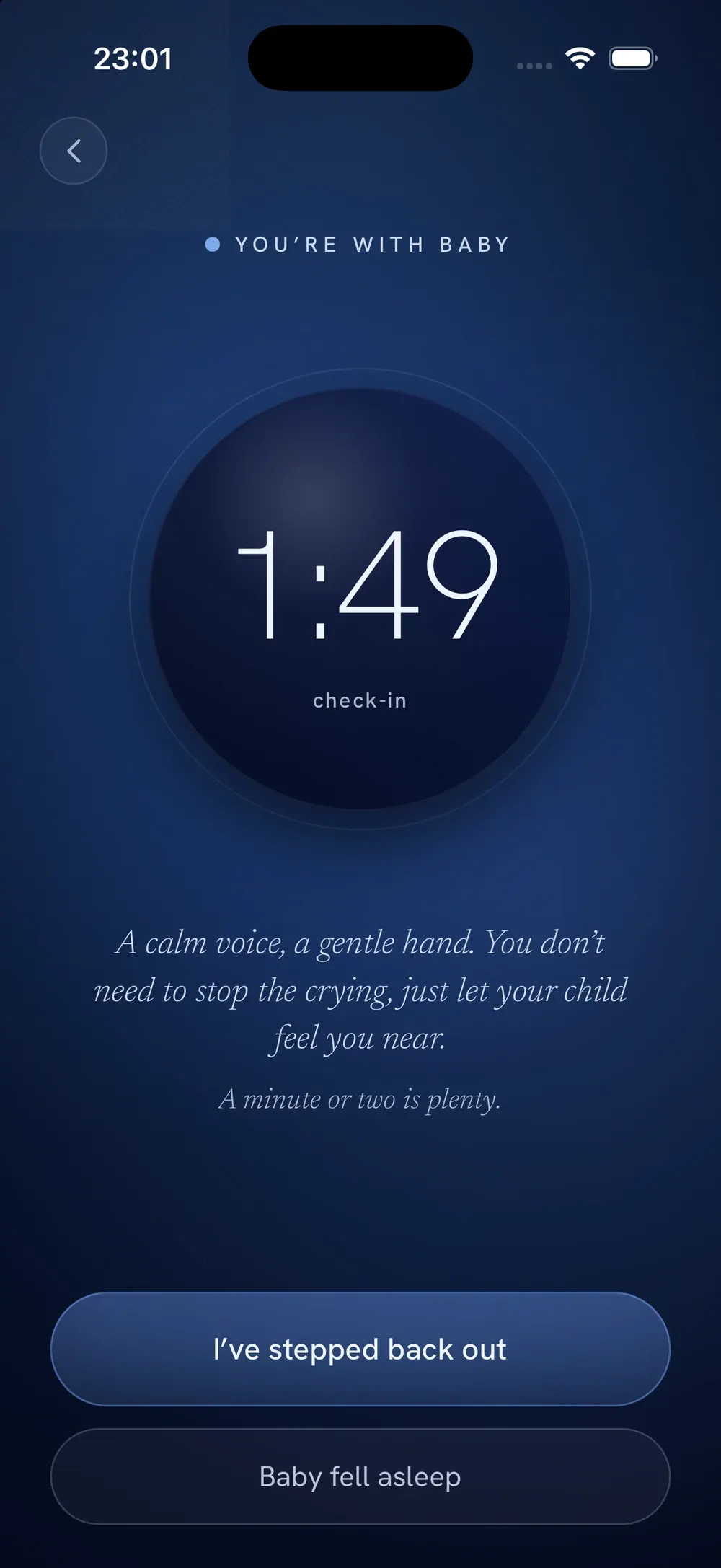
The timer goes off. Your baby is still crying, and it is time to go in. You stand at the door with your hand on the handle and realize you are not sure what you are supposed to do once you are inside.
Here is the short answer. During a Ferber check-in, you go in calmly, keep the lights off, say a few quiet words, perhaps rest a hand on your baby or pat them briefly, and leave. You do not pick them up to settle them, feed them or stay until they fall asleep. The whole visit is short: the Sleep Foundation suggests under one to two minutes. The point is to let your baby know you are close, not to stop the crying. The rest of this page covers the moments that do not fit the script.
What to do during a Ferber check-in, step by step
- Wait for the full interval. Only go in if your baby is still crying when the wait ends. The waits are for crying, not for fussing or babbling. The Ferber method chart has tonight’s numbers.
- Go in quietly, lights off. The Cleveland Clinic suggests going back in quietly and leaving the lights off to avoid stimulating your baby. A dim hall light behind you is enough to see by.
- Check that all is well. A quick look: breathing normally, nothing tangled, nothing in the crib that should not be there.
- Say your words. Something short and the same every time.
- Touch briefly, if it helps. A pat on the back or a hand on the chest for a moment. The Sleep Foundation says you can pat or speak softly.
- Leave, even if they are still crying. Then start the next wait.
That is the whole thing. It is meant to be a little boring.
If you want the thinking behind check-ins, and why they are the difference between Ferber and cry it out, our guide to check-ins explained covers it. This page is the practical version for the moment you are standing at the door.
What to say
Pick a short phrase before Night 1 and use it at every check-in, all week. Some parents use:
- “It’s okay. It’s time to sleep. I love you.”
- “Shh, shh. Mommy’s here. Night night.”
- “You’re okay. Time for sleep.”
The Cleveland Clinic describes the same idea: you can shush or talk quietly, with words like “Mommy’s here, Daddy’s here.” The exact words matter less than keeping them calm, quiet and the same, so the visit becomes predictable. A low, even tone usually works better than a cheerful or apologetic one.
If you share check-ins with a partner, agree on the words together. It is one less thing to decide at 2 a.m.
How long to stay
Short. The Sleep Foundation suggests keeping check-ins under one to two minutes, and the Cleveland Clinic says not to linger. The Ferber app times each check-in for 2 minutes by default. Treat that as an upper limit rather than a target. If you have said your words and given a pat, you are done, even if only 30 seconds have passed.
The reason is simple. A visit that keeps growing, a bit more patting, a bit more shushing, sitting down “for a second,” starts to become the new way your baby falls asleep. Then you are needed at every waking again.
Your baby may stop crying while you are there and start again as you walk out. That is expected. Leave anyway, and begin the next wait.
What not to do
- Do not pick up to settle. The Sleep Foundation and the Cleveland Clinic both say not to pick your baby up during check-ins. If a pickup after a long cry becomes the pattern, your baby learns that crying longer brings more help.
- Do not feed during a check-in. If your pediatrician wants a night feed kept, keep that one feed at its usual time, separate from the check-ins. Whether your baby still needs a night feed is a pediatrician question.
- Do not turn the lights on or start playing, chatting or singing.
- Do not stay until they are asleep. That turns the check-in into the thing you were trying to change.
- Do not change the plan mid-night. Shrinking the waits because the crying is louder can teach the same lesson as a pickup.
A slip is not a disaster. If you picked your baby up once, put them down, leave, and run the next wait as normal.
When to skip or shorten a check-in
Skip it if the crying has stopped. If your baby quiets before the wait ends, you do not go in. If they start crying again, start timing that wait again.
Skip it if they are fussing, not crying. Grumbling, babbling, rolling around and talking to themselves are all fine, and there is no need to go in.
Shorten it if your visit seems to wind your baby up. Some babies get more upset when they see a parent come and go. If that seems to be happening, make the check-in quieter and briefer: a few words from beside the crib and out. Some parents find a calm voice from the doorway works better than going all the way in.
Change the plan before bedtime, not during it. The Sleep Foundation notes that the intervals can be adjusted to suit caregivers. If you want gentler waits or a different check-in style, decide before the night starts and use it every time.
A practical detour is not a failed check-in. The AAP notes that you may still need to attend to your baby’s needs, such as a feed, a dirty diaper or comfort when they are sick. For a dirty diaper, keep the lights low, change them with as little fuss as you can, put them back down on their back, and restart the wait if they are still crying.
When to stop and comfort instead
Check-ins are for a healthy baby protesting a change. They are not for a baby who is unwell or hurt.
If your baby vomits, go in, pick them up, clean them up and change the crib sheet. If they seem unwell, have a fever or vomit again, stop for the night. The American Academy of Pediatrics advises calling your pediatrician right away if a baby with a fever looks very ill, is unusually drowsy or very fussy, has trouble breathing, or has repeated vomiting or diarrhea. Even if your baby seems fine afterward, stopping for the night is always a reasonable choice.
If you think your baby is teething or getting sick, comfort them and pause. The guide to teething and illness covers when and how to pick back up.
If you are not sure, go in and look. Checking on a baby you are worried about is never a mistake.
When you put your baby back down, the safe sleep basics still apply: on their back, on a firm, flat surface in their own crib, with no pillows, blankets, bumpers or soft toys. The AAP’s safe sleep guide has the details.
Before tonight’s first check-in
Choose your words, agree on them with anyone else doing check-ins, and decide ahead of time how you will handle a dirty diaper or a sick baby so you are not deciding while tired. If you are early in the week and nights feel harder, not easier, our articles on why Night 2 or 3 can be worse and how long the Ferber method takes explain what is normal. The glossary entry for check-ins is a quick refresher.
When it is time to go in, the Ferber app tells you, then times the check-in (2 minutes by default) and runs the next wait.
Common questions
How long should a Ferber check-in last?
Short. The Sleep Foundation suggests under one to two minutes. The Ferber app times each check-in for 2 minutes by default, and many parents are out sooner than that.
Can I pick my baby up during a check-in?
Not to settle them to sleep. A check-in is a calm voice and perhaps a pat, then out. Picking up briefly to change a dirty diaper, clean up after vomiting or comfort a baby who is sick or hurt is different, and always fine.
Should I go in if my baby is fussing but not really crying?
No. The waits are for crying. If your baby is fussing quietly, babbling or rolling around, leave them to it. If they stop crying before a wait ends, you do not go in either.
What should I do if my baby vomits during Ferber?
Go in, pick them up, clean them and the crib, and comfort them. If they seem unwell, have a fever or vomit more than once, stop for the night and call your pediatrician if you are worried. Stopping for the night is always fine.
Sources
- Sleep Foundation: The Ferber Method
- Cleveland Clinic: What Is the Ferber Method?
- American Academy of Pediatrics (HealthyChildren.org): Getting Your Baby to Sleep
- American Academy of Pediatrics (HealthyChildren.org): When to Call the Pediatrician: Fever
- American Academy of Pediatrics (HealthyChildren.org): A Parent's Guide to Safe Sleep