Research
Is the Ferber method safe? What the research says
What studies of graduated extinction found about stress, attachment and long-term effects, their limits, and what safe looks like in practice.
You have read that sleep training helps. You have also read that it floods babies with stress hormones and damages attachment. Both claims show up in the same search results, often with the same confidence, and you are the one who has to decide at 8 p.m. tonight.
Here is the short answer. For a healthy baby around 6 months or older, sleeping in a safe crib, the Ferber method (researchers call it graduated extinction) has good evidence behind it. In the best long-term study, children’s emotions, behavior, stress and relationship with their parents at age 6 were no different whether or not their families had sleep trained. The research has real limits, which this page sets out, and “safe” also depends on how and when you do it.
What the research found
Graduated extinction is one of the most studied approaches to infant sleep. Five studies come up again and again, and each one answers a slightly different question.
Does it work? A review of 52 treatment studies for the American Academy of Sleep Medicine found that 94% reported behavioral treatments were effective, with over 80% of children showing clinically meaningful improvement that held for 3 to 6 months. It found support for graduated extinction alongside other approaches (Mindell et al., 2006).
Does it help parents too? In an Australian trial of 156 mothers of babies aged 6 to 12 months with severe sleep problems, more sleep problems had resolved at 2 months in the group taught controlled crying. Mothers’ depression scores also fell, and for mothers who started with high scores, that improvement was still there at 4 months. By 4 months, though, the two groups’ sleep problems looked similar (Hiscock and Wake, 2002). That detail matters: the main benefit looked like getting to better sleep sooner.
What about stress and attachment? A randomized trial put 43 babies aged 6 to 16 months into graduated extinction, bedtime fading or a sleep education control group. Graduated extinction cut the time babies took to fall asleep and how often they woke. Babies’ salivary cortisol, a stress hormone, showed small to moderate declines compared with the control group, not rises. Twelve months later there were no differences in emotional or behavioral problems or in attachment (Gradisar et al., 2016).
Is the Ferber method safe in the long run?
This is the question most parents are really asking, and it has the most direct answer.
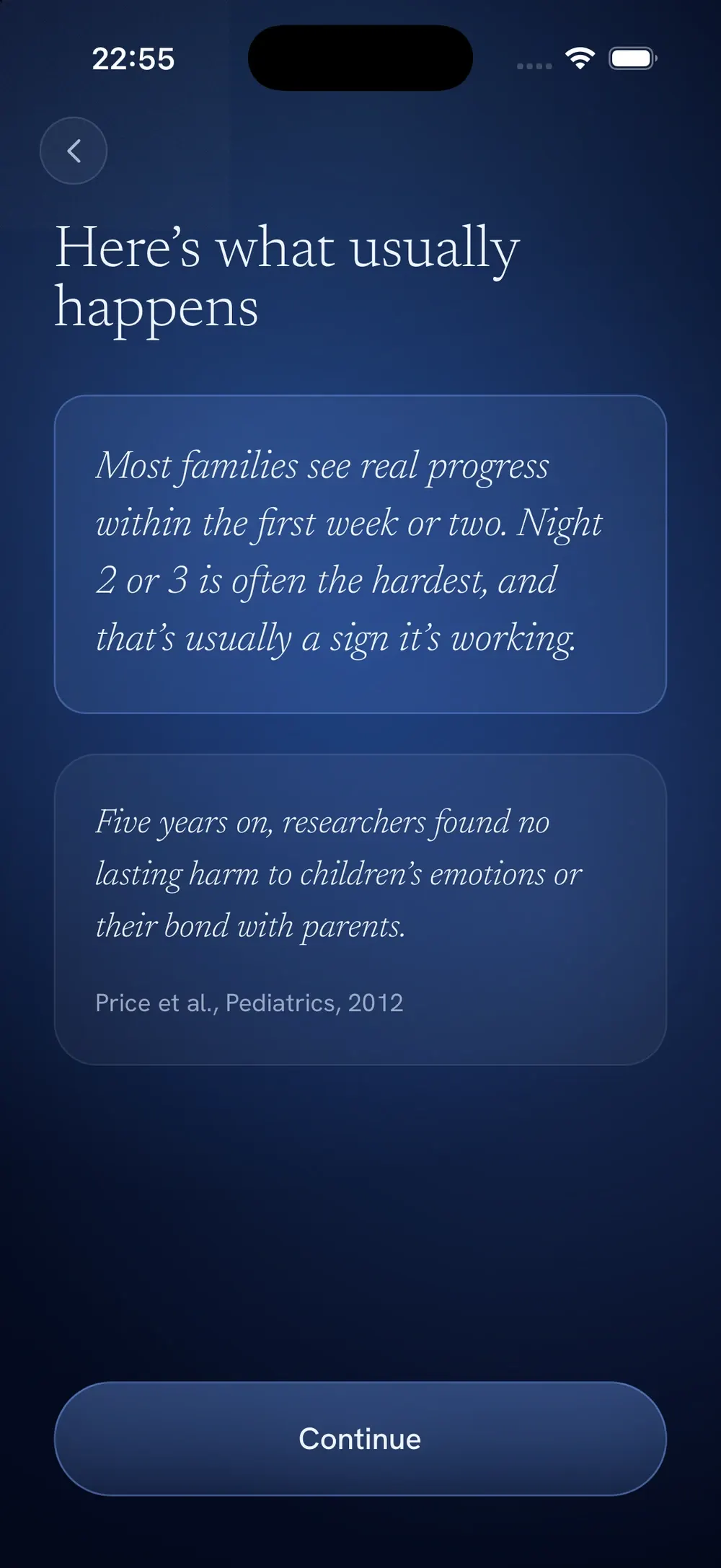
A trial taught behavioral sleep techniques to families at infant age 8 to 10 months, then followed them up when the children were 6 years old. Researchers compared 225 families across child mental health, sleep, stress, the parent-child relationship, attachment and parents’ own mental health. There was no evidence of a difference on any outcome. The authors concluded that behavioral sleep techniques have “no marked long-lasting effects (positive or negative)” (Price et al., 2012).
Read that both ways. It means sleep training did not harm these children. It also means it did not give them some lasting advantage. It is a tool for a hard stretch of months, not a gift or a wound that follows a child into school. If your family is coping fine without it, there is nothing you are missing.
The study behind the stress worries
If you have seen the claim that sleep-trained babies stay stressed after they stop crying, it usually traces back to one study (Middlemiss et al., 2012).
Researchers measured cortisol in 25 babies aged 4 to 10 months during a 5-day inpatient sleep program. By day 3, the babies no longer showed distress at bedtime, but their cortisol was still raised. Their mothers’ cortisol had dropped.
That is a real finding and worth taking seriously. It is also worth knowing its limits:
- It was small. Twenty-five babies.
- It used full extinction, not graduated extinction. Parents did not check in at intervals, which is the defining feature of the Ferber method.
- It was an inpatient program, not the baby’s own room at home.
- It had no comparison group, so there is no way to know what those babies’ cortisol would have done without the program.
The larger, randomized trial above, which did test graduated extinction and did have a control group, found cortisol went down slightly rather than up (Gradisar et al., 2016). Our research page goes through all of these studies in more depth.
What safe means in practice
The research describes healthy babies, in typical homes, at sensible ages. Safe for your baby means matching those conditions.
Age. Sleep training is not recommended before about 4 months. Six months is a common starting point. If your baby is under 6 months, talk to your pediatrician first. If your baby was born early, ask your pediatrician which age to go by.
A safe sleep space, every time. The Ferber method changes how your baby falls asleep, never where. The American Academy of Pediatrics recommends placing babies on their back, on a firm, flat surface, in their own crib or bassinet, with a fitted sheet and nothing else: no pillows, blankets, bumpers or soft toys. It recommends room sharing without bed sharing for at least the first 6 months (AAP, A Parent’s Guide to Safe Sleep). Every wait and every check-in happens with your baby in that space.
Feeds. Whether your baby still needs a feed at night is a question for your pediatrician. If they say keep one, keep it, and use the method for the other wakings.
Who the Ferber method may not suit
The studies above show the method is reasonable for many families. That does not make it right for every family.
- Babies with health, feeding or growth concerns. Get your pediatrician’s view first.
- Weeks of upheaval. Illness, travel, a move or a new daycare make a poor starting point. The teething and illness guide covers when to wait.
- Parents who cannot bear the crying. That is not a failing. A plan you can follow calmly every night matters more than which plan it is. The chair method and bedtime fading involve less time apart, and our comparison of methods sets them side by side.
- Parents who are running on empty. If you are feeling low, hopeless or unlike yourself, please talk to your own doctor. Sleep training is not a fix for that, and you deserve support in your own right.
- Families for whom current sleep works. If nobody is struggling, nothing needs changing.
It is also fine to stop partway. Pausing for a sick night, switching to a gentler method, or deciding this is not the month are all safe choices.
A calm next step
If your baby is healthy, at least around 6 months old, and your pediatrician has no concerns, a good next step is to read how a night actually runs in the Ferber method, explained and to decide in advance what your check-ins will look like. Knowing that Night 2 or 3 can be louder than Night 1 helps too.
If you want help with the timing, the Ferber app is inspired by the Ferber method: it is designed for babies around 6 months and older, won’t start a plan under 4 months, and runs each wait and check-in for you so you can stay calm in the moment.
Common questions
Does the Ferber method cause long-term harm?
The longest follow-up so far tracked children from an infant sleep trial to age 6 and found no differences in emotional or behavioral problems, stress, sleep, or the parent-child relationship. The authors concluded that behavioral sleep techniques have no marked long-lasting effects, positive or negative.
Does the Ferber method raise a baby's cortisol?
In a randomized trial of babies aged 6 to 16 months, cortisol showed small to moderate declines with graduated extinction compared with a control group. A small study of full extinction in an inpatient program found cortisol was still raised on day 3. That study had no comparison group and did not test the Ferber method.
What is the youngest age for the Ferber method?
Sleep training is not recommended before about 4 months, and 6 months is a common starting point. If your baby is under 6 months, was born early, or has any feeding or growth concern, talk to your pediatrician first.
Can I stop the Ferber method if it does not feel right?
Yes. You can pause for illness, travel or simply because it is not the right time, and you can choose a gentler approach instead. Not sleep training at all is also a reasonable choice.
Sources
- Price AMH et al. Five-year follow-up of harms and benefits of behavioral infant sleep intervention. Pediatrics, 2012
- Gradisar M et al. Behavioral interventions for infant sleep problems: a randomized controlled trial. Pediatrics, 2016
- Middlemiss W et al. Asynchrony of mother-infant HPA axis activity following extinction of infant crying responses. Early Human Development, 2012
- Hiscock H, Wake M. Randomised controlled trial of behavioural infant sleep intervention to improve infant sleep and maternal mood. BMJ, 2002
- Mindell JA et al. Behavioral treatment of bedtime problems and night wakings in infants and young children. Sleep, 2006
- American Academy of Pediatrics (HealthyChildren.org): A Parent's Guide to Safe Sleep