By age
The Ferber method at 6 months: what to expect
Six months is a common age to start the Ferber method. How to tell if your baby is ready, where night feeds fit, safe sleep, and what the first week is like.
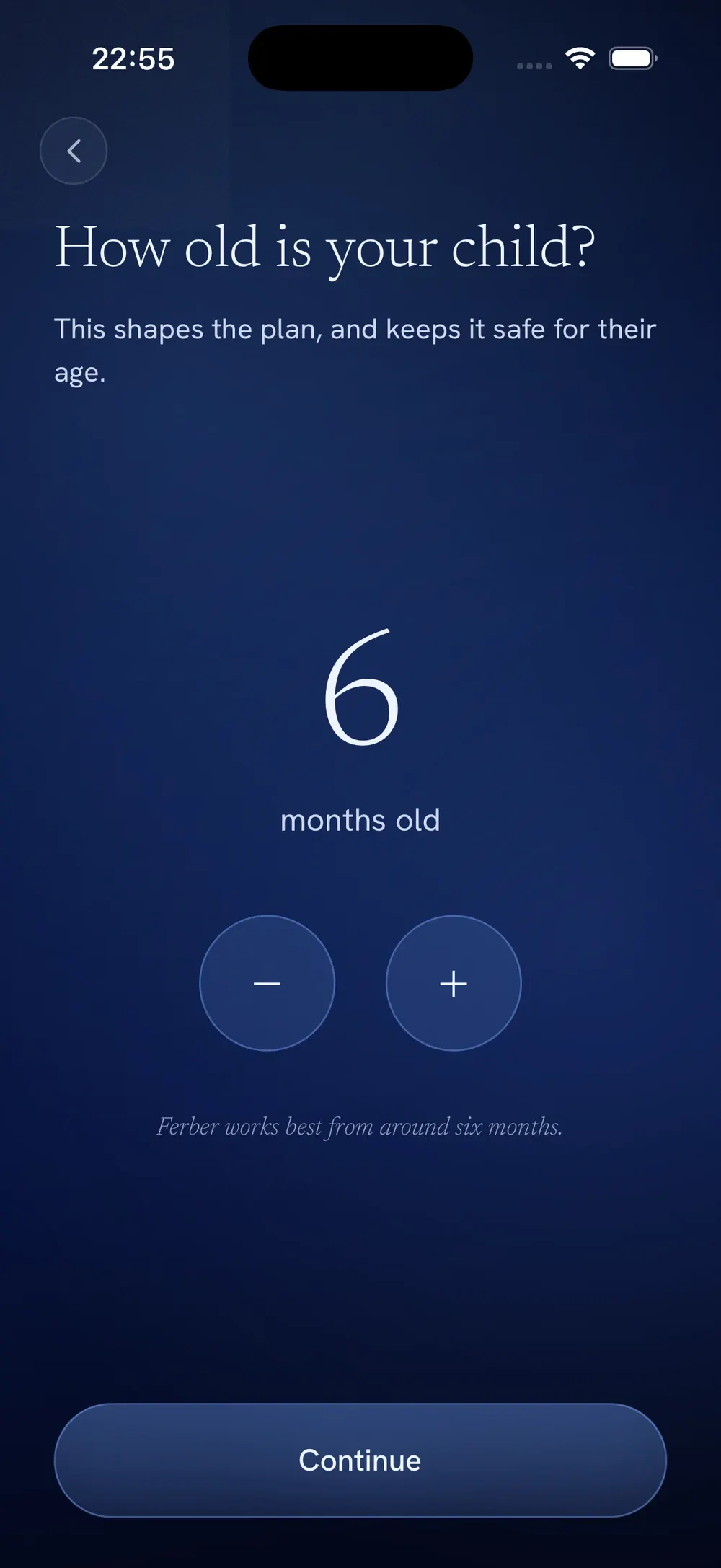
Your baby has just had their six-month checkup. They are rolling, grabbing, laughing at the dog, and still waking three times a night asking to be rocked back down. Someone at the checkup mentioned the Ferber method, and now you are wondering whether six months is the right time.
For many families, it is. Six months is one of the most common ages to start the Ferber method, and the Sleep Foundation says sleep training, including Ferber, can start once a child is 6 months old. The method itself works the same way at 6 months as it does later. What is specific to this age is a short list of checks first: your baby’s health, whether a night feed still matters, their corrected age if they were born early, and a sleep space that fits a baby who can now roll.
Why 6 months is a common starting point
By around 6 months, many babies can learn to fall asleep on their own. The American Academy of Pediatrics suggests that from 4 months, babies go to bed drowsy but awake, because a baby who is rocked or held to sleep may struggle to go back to sleep when they wake in the night. The same AAP page notes that it is normal for a 6-month-old to wake during the night and go back to sleep after a few minutes.
That is the gap the Ferber method is designed to close. A baby who always falls asleep being fed, rocked or held has learned a sleep association that disappears once they are in the crib. When they surface between sleep cycles, they call for it back. The method gives them the chance to build a way of settling that is still there at 2 a.m.
Six months is a common age, not a deadline. There is no benefit to rushing, and nothing is lost by waiting a few weeks for a calmer stretch of life.
Is your 6-month-old ready for the Ferber method?
A few honest questions before Night 1:
- Is your baby well? Start when your baby is healthy, feeding well and growing well. If your pediatrician has any concern about weight, reflux, breathing or feeding, that conversation comes first.
- Was your baby born early? For premature babies, the AAP explains how to work out corrected age: take the weeks since birth and subtract the weeks your baby was born early. A baby who is 6 months since birth but was born two months early has a corrected age of about 4 months. Ask your pediatrician which age to go by before you start sleep training.
- Is this an ordinary week? Avoid starting during travel, a move, a new daycare or a round of vaccinations.
- Are the adults agreed? Everyone who does bedtime or night wakings needs to follow the same plan. Our guide to co-parenting and consistency covers how to get there.
If the answer to any of these is “not yet,” waiting is a perfectly good plan.
Night feeds at 6 months
This is the question most parents of 6-month-olds have, and the honest answer is that it depends on your baby. The NHS notes that for some babies aged 6 months to a year, night feeds may no longer be necessary, and that hunger may still wake some babies at night. Which group your baby is in is a question for your pediatrician, who knows their weight and growth.
If your pediatrician wants a night feed kept, the method still works. Keep that one feed, and use the check-ins for the other wakings. One simple approach is to feed at the first waking after a time you agree with your pediatrician, or at a planned time, and then treat every other waking the same way as bedtime. Keep the feed calm and dim, and try to put your baby back in the crib awake afterward, so the feed does not become the new way to fall asleep. The glossary entry on the dream feed describes one option some families use.
What the method never asks you to do is withhold a feed your pediatrician says your baby needs.
Safe sleep for a baby who can roll
Many 6-month-olds are rolling (the AAP notes rolling usually starts around 3 to 4 months), and that changes a few things about the crib.
The AAP says to always place your baby on their back to sleep. If your baby can roll both ways, from back to tummy and tummy to back, you do not need to keep turning them onto their back. What matters is that the crib is bare: no blankets, pillows, stuffed toys or bumpers that a rolling baby could press their face into.
Swaddling is the other common change. The AAP says to stop swaddling when your baby looks like they are trying to roll over, because the risk of suffocation is higher if a swaddled baby rolls onto their stomach. If you are still swaddling at 6 months, stop before you start the method rather than changing both at once, and give your baby a few nights to get used to sleeping with free arms. A wearable blanket is an option if you are worried about your baby getting cold. The AAP says not to use weighted blankets, sleepers or swaddles.
What the first week can look like
The chart is the same at 6 months as at any other age. On Night 1 you wait 3 minutes before the first check-in, then 5, then 10, and keep waiting 10 minutes between check-ins until your baby is asleep.
| Night | 1st wait | 2nd wait | 3rd wait, then every wait |
|---|---|---|---|
| Night 1 | 3 min | 5 min | 10 min |
Waits are in minutes. After the third wait, keep repeating the third value until your baby is asleep. If your baby wakes later in the night, start again from that night's first wait.
Each later night starts a little longer. The full chart has every night, and our guide to the first night walks through the evening itself.
Some things parents of 6-month-olds often notice:
- Night 1 can be loud. Your baby is surprised by the change and says so. For many parents, the ten-minute waits are the hardest part.
- Nights 2 and 3 can be harder than Night 1. This is common, usually brief, and not a sign the method is failing. Our guide to the hard middle explains why.
- Night wakings restart the chart. When your baby wakes and cries later in the night, start again from that night’s first wait.
- Every baby is different. The Sleep Foundation says progress typically comes within three to seven nights, though it varies with temperament. Some babies take longer. No method can promise a particular night.
For context on how much sleep to aim for overall, the American Academy of Sleep Medicine recommends that babies 4 to 12 months old sleep 12 to 16 hours per 24 hours, including naps. That is a wide range, and it covers the whole day, not just the night.
When to pause
Stop and comfort your baby if they seem sick, hurt or in pain, have a fever, have vomited, or are crying in a way that feels different from ordinary protest. The method is a structure for learning, not a test of endurance, and you can start again once your baby is well. Our guide to teething and illness covers how to restart.
If your baby snores, has pauses in their breathing, or is not gaining weight as expected, see your pediatrician before sleep training.
It is also fine to decide the Ferber method is not for your family. If you want something slower, the chair method and other approaches are set out side by side on our comparison page. And if the way your family sleeps right now is working, there is nothing to fix.
One thing to do tonight
Pick a short bedtime routine you can repeat in the same order every night, with the feed near the start rather than the end. Run it for a few nights before Night 1, so the routine is familiar before anything else changes. Our age guide for 6 months has more on sleep at this stage, and the method overview covers the approach in full.
The Ferber app is designed for babies around 6 months and older and won’t start a plan under 4 months. It runs each wait for you, tells you when to check in, and keeps a record of every night so you can see the week change.
Common questions
Is 6 months too early for the Ferber method?
No. Six months is a common starting age, and the Sleep Foundation says sleep training, including the Ferber method, can start once a child is 6 months old. Sleep training is not recommended before about 4 months. If your baby has any health, feeding or growth concern, talk to your pediatrician first.
Does my 6-month-old still need a night feed?
Some do and some do not, and it is a question for your pediatrician, not a sleep chart. If your pediatrician wants a feed kept, keep it and use the method for the other wakings.
My baby was born early. Do I count from their birthday?
Talk to your pediatrician. For premature babies, the AAP explains how to work out corrected age, which accounts for how early your baby was born, so a baby who is 6 months since birth may be younger in developmental terms.
Should I stop swaddling before starting Ferber at 6 months?
The AAP says to stop swaddling when your baby looks like they are trying to roll over, and notes that rolling usually happens around 3 to 4 months. A wearable blanket is an option if you are worried about your baby getting cold.
Sources
- Sleep Foundation: The Ferber Method
- American Academy of Pediatrics (HealthyChildren.org): Getting Your Baby to Sleep
- American Academy of Pediatrics (HealthyChildren.org): A Parent's Guide to Safe Sleep
- American Academy of Pediatrics (HealthyChildren.org): Corrected Age for Preemies
- Paruthi S et al. Recommended amount of sleep for pediatric populations: a consensus statement of the American Academy of Sleep Medicine. J Clin Sleep Med, 2016
- NHS: Helping your baby to sleep