By age
Ferber at 12 months and older
The Ferber method can still work at 12 months and older. How to adapt the waits, handle calling out and climbing, and keep the crib safe.
Your child just had their first birthday, and bedtime still involves a long rock, a feed, or someone lying on the floor next to the crib until they drop off. You held off on sleep training as a baby, and now you are wondering whether the Ferber method still makes sense for a child who walks, babbles and knows exactly what they want.
The Ferber method can still work at 12 months and older. The Sleep Foundation says it can be effective for toddlers, particularly when it is adapted to their developmental stage. The core stays the same: you put your child down awake, wait a set interval if they cry, check in briefly, and wait a little longer each time. What changes after the first birthday is how your child protests. They may stand, call for you by name, stall at bedtime or try to climb out, so the plan needs a few adjustments and a crib that is safe for a stronger, more mobile child.
Can you use the Ferber method at 12 months?
Yes. There is no upper age limit on the method. One randomized trial of graduated extinction, the research term for the Ferber method, enrolled children from 6 up to 16 months old. It found the approach reduced how long children took to fall asleep and how often they woke, compared with a control group, with no differences in emotional or behavioral problems or attachment a year later.
The usual checks apply before Night 1. Your child should be healthy and well for at least a few days. The week ahead should be fairly settled, without a trip, a new daycare or a big change at home. And every adult who does bedtime should agree on the plan. If your child still has a night feed, ask your pediatrician whether it is still needed. The age guide for 12 to 18 months covers the wider picture for this stage, and if you are still deciding on timing, see what age you can start the Ferber method.
What changes after the first birthday
The biggest difference is that your child now has opinions and ways to express them.
Separation anxiety may still be strong. The American Academy of Pediatrics (AAP) says separation anxiety can begin in the second half of the first year, can cause many nights of disrupted sleep, and usually fades somewhere around the second birthday. It recommends a loving and consistent approach. A Ferber week, with its short and predictable check-ins, fits that well.
The protest is louder and more specific. A 1-year-old may call “Mama” or “Dada” through the door, throw things out of the crib, or stand and rattle the rail. That can be much harder to listen to than crying. It is also normal, and keeping every check-in the same gives your child something predictable to rely on.
Bedtime stalling begins. One more book, one more drink, one more hug. Stalling often stretches bedtime, which can mean an overtired child and a harder first stretch of crying.
Adjusting the waits for an older child
The Sleep Foundation notes that the check-in intervals can be modified to fit caregivers’ needs. With an older baby or toddler, some families find that very frequent check-ins wind their child up more, because each visit is a reminder that a parent might stay. Those families sometimes prefer slightly longer waits. Others prefer shorter ones. Either is fine if you choose before bedtime and keep the same waits all night.
Here is the chart the Ferber app uses, which is the same at every age:
| Night | 1st wait | 2nd wait | 3rd wait, then every wait |
|---|---|---|---|
| Night 1 | 3 min | 5 min | 10 min |
| Night 2 | 5 min | 10 min | 12 min |
| Night 3 | 10 min | 12 min | 15 min |
| Night 4 | 12 min | 15 min | 17 min |
| Night 5 | 15 min | 17 min | 20 min |
| Night 6 | 17 min | 20 min | 25 min |
| Night 7 | 20 min | 25 min | 30 min |
Waits are in minutes. After the third wait, keep repeating the third value until your baby is asleep. If your baby wakes later in the night, start again from that night's first wait.
Keep check-ins short and boring. The Sleep Foundation suggests keeping them under one to two minutes, with a pat or a soft voice, and without picking your child up or feeding them. Our guide to what to do during a check-in has ideas for what to say, and the Ferber method chart explains why the waits grow.
Calling out, standing and climbing
Calling out. If your child is chatting, singing or calling quietly without crying, there is no need to go in. The waits are for crying. If they cry and call for you, keep to the plan: wait the interval, check in calmly with your usual words, and leave.
Standing. Some children this age still stand and cry at the rail. At each check-in, you can lay your child down once and then leave, even if they stand straight back up.
Throwing things out of the crib. A child who throws a toy or pacifier over the side may cry for it back. You can return it once at a check-in if you like, and otherwise leave it for the morning.
Climbing. Treat climbing as a safety question first.
Crib safety and when to think about a bed
The AAP’s guidance on bigger beds says that once a toddler can climb out of their crib, it may be time to move to a “big kid” bed. If that happens, it suggests childproofing the room: clearing away furniture and large toys your child could fall against, securing drawers so they cannot be used as steps, and using a safety gate at the bedroom door or top of the stairs so your child cannot wander while you are asleep.
If your child is not climbing, there is often no rush to switch. Many families find it easier to run the Ferber method in a familiar crib and leave the bed for later, so your child is not learning two new things at once. The 18 months and beyond guide covers the move to a bed in more detail.
The general safe sleep rules still apply at bedtime: a firm, flat mattress in a crib that meets current standards, nothing in the crib your child could climb on, and a room free of hazards. The AAP safe sleep guide is the reference. If your child is sick, feverish, vomiting or crying in a way that sounds like pain, stop the plan, comfort them, and call your pediatrician if you are worried.
A bedtime routine that holds up to stalling
A short, predictable routine is your best defense against stalling. Pick the steps and the order, for example bath, pajamas, two books, a song and into the crib, and do the same thing every night. Telling your child what is coming helps too: “Two books, then it is time for bed.”
Build the requests you can predict into the routine. Offer the drink before books. Do the extra hug as part of the song. Then, once the light is off, the routine is over and the Ferber waits begin. The glossary entry on the bedtime routine has more.
A next step for tonight
Tonight, check the crib: mattress on its lowest setting, nothing inside your child could stand on, and any bumper pads removed. Then write down your bedtime routine, step by step, and agree on it with anyone else who puts your child to bed.
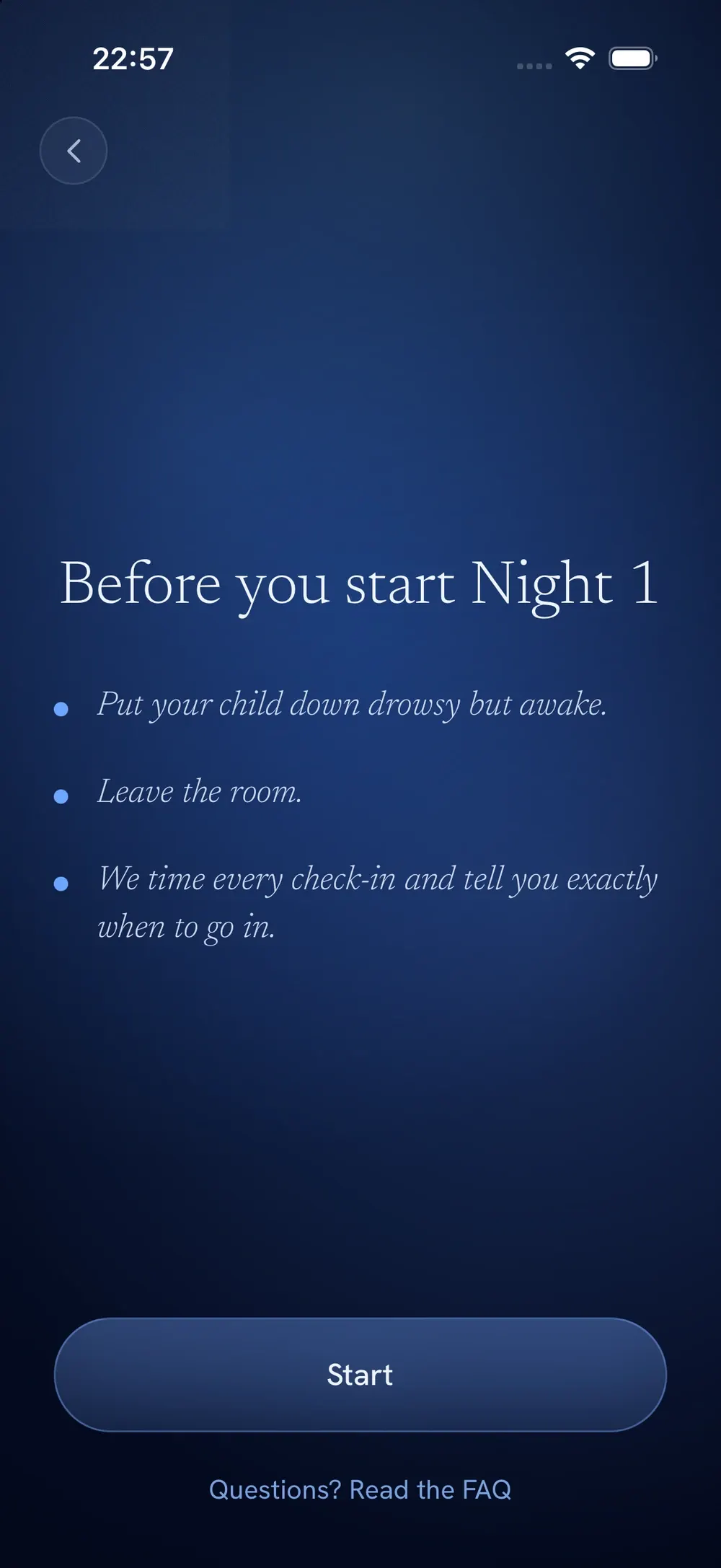
The Ferber app runs every countdown, alerts you at check-in time, times the check-in (2 minutes by default), and keeps a sleep history, so you can see how bedtime and wakings change over the week.
Common questions
Can you do the Ferber method with a 12-month-old?
Yes. The Sleep Foundation says the Ferber method can be effective for toddlers, particularly when it is adapted to their developmental stage. The basics stay the same: put your child down awake, wait a set interval if they cry, check in briefly, and wait a little longer each time.
Should the Ferber intervals be longer for a 1-year-old?
They can be, but they do not have to be. The Sleep Foundation notes that the intervals can be modified to fit caregivers' needs. Some families with an older baby find shorter, frequent check-ins wind their child up, and prefer slightly longer waits. Decide before bedtime and keep the same waits all night.
What if my toddler climbs out of the crib during Ferber?
Treat climbing as a safety issue first. The American Academy of Pediatrics says the most common crib falls happen when a child tries to climb out, and that once a toddler can climb out it may be time to move to a bed. Keep the mattress at its lowest setting and talk to your pediatrician if you are unsure.
My 1-year-old calls for me by name during Ferber. What should I do?
It is hard to hear, and it is normal. Keep to the same waits and the same short check-ins. Hearing your calm voice at predictable times tells your child you are close. If your child seems unwell or frightened by something real, go in and comfort them.
Sources
- Sleep Foundation: The Ferber Method
- American Academy of Pediatrics (HealthyChildren.org): Separation Anxiety and Sleeping
- American Academy of Pediatrics (HealthyChildren.org): Make Baby's Room Safe, Parent Checklist
- American Academy of Pediatrics (HealthyChildren.org): Big Kid Beds, When to Switch From a Crib
- Gradisar M et al. Behavioral interventions for infant sleep problems: a randomized controlled trial. Pediatrics, 2016
- American Academy of Pediatrics (HealthyChildren.org): A Parent's Guide to Safe Sleep