Toddlers
Can you use the Ferber method with a toddler?
Yes, the Ferber method can work past the first birthday. Toddlers protest differently, stall and climb, so here is how to adapt it safely.
Maybe you did not want to sleep train a baby. Maybe you tried, and life got in the way. Now your child is 15 months or 2 years old, still needs you to fall asleep, and everyone is tired. You may be wondering whether you missed the window.
You did not. The Ferber method can be used with toddlers. Research on behavioral sleep approaches covers infants and young children, not just babies, and the Sleep Foundation says the Ferber method can be effective for toddlers when it is adapted to their developmental stage. What changes is how your child protests, the new ways they can get out of bed, and the safety questions that come with a bigger, more mobile child.
The Ferber method for toddlers: what stays the same
The core of the method does not change with age. After a calm, predictable bedtime routine, you leave your child awake in their own sleep space. If they cry, you wait a set time before a brief check-in, and the waits grow gradually longer across the night and the week. If you want the full walkthrough, see the Ferber method, explained.
The evidence base reaches past the first birthday too. An American Academy of Sleep Medicine review of 52 treatment studies on bedtime problems and night wakings in infants and young children found that behavioral treatments were effective in the great majority of studies, with support for graduated extinction (Mindell et al., 2006).
No study can promise how your child will respond. But age alone is not a reason to rule the method out.
How toddlers protest differently
A 7-month-old cries. A toddler has more tools, and will use them.
- Words. “Mama.” “Water.” “One more book.” “I need a hug.” Requests are harder to hear than crying because they sound reasonable.
- Standing, shaking the rail, throwing things out of the crib. Loud, but not a reason to change the plan on its own.
- Stalling at bedtime. The routine stretches as your child discovers that every request buys a little more time with you.
- Testing. The Sleep Foundation notes that older children may understand verbal reassurance and bedtime routines better, but can also test limits, so consistency and clear expectations matter.
Two things help. First, make the bedtime routine predictable and finite: the same steps in the same order, ending with the same words each night. Handle the usual requests (a drink of water, a last trip to the potty if they use one, a favorite book) inside the routine, before lights out, so there is less to ask for afterward. The glossary entry on bedtime routines has more on why this matters.
Second, keep check-ins short and dull. A toddler understands more, so one calm, repeated phrase (“It’s sleep time. I love you. See you in the morning.”) can reassure without opening a conversation. Answering each new request turns check-ins into a game worth staying awake for.
Climbing out of the crib: a safety question first
If your child has started climbing out, or looks close to it, deal with the fall risk before you think about intervals.
The AAP’s guidance on switching to a big kid bed says that once a toddler can climb out of the crib, it may be time for the move. It also covers making the room safe for a child who can now wander at night: clearing furniture and large toys they could fall on, using a safety gate at the bedroom door and at the top of stairs, latching or taping drawers shut, and anchoring furniture so it cannot tip.
The big-bed version: returning your child to bed
Once your child is in a bed, the classic Ferber picture of a crying child waiting in a crib no longer fits. A child in a bed can simply get up and come to find you.
The AAP describes the approach for a child who keeps leaving bed: calmly and quietly lead them back, keep every interaction brief and boring, and praise them for staying in bed rather than giving attention for getting out. It also notes that many return trips in a single evening are not unusual, so a long first night does not mean it is failing.
If you want to keep the Ferber structure, one option is to combine the two: return your child to bed each time they get up, then use gradually longer, timed check-ins if they cry from bed. Whatever version you use, every adult needs to do the same thing, every time. There is more on getting partners on the same page in co-parenting and consistency.
Timing matters too. Starting a new bed and sleep training in the same week asks a lot of a small child. If you can, let your child get used to the new bed first, or start the method while they are still safe in the crib.
Sleep amounts and schedules at this age
A bedtime that is too early for your child’s sleep needs can look like resistance. The American Academy of Sleep Medicine recommends 11 to 14 hours per 24 hours, including naps, for children 1 to 2 years old (Paruthi et al., 2016). Some toddlers sit at the low end of that range. If your child lies awake and happy for a long stretch at bedtime every night, a slightly later bedtime may help, a technique known as bedtime fading.
Naps count toward that total. If you are working on daytime sleep as well, see the Ferber method for naps. For age-specific detail, see Ferber at 12 to 18 months and Ferber at 18 months and beyond.
Pause and talk to your pediatrician if your child is sick or in pain, snores, seems to pause in their breathing, or if you have concerns about their growth or eating. None of that is a sleep-training problem.
A next step for tonight
Tonight, before you start anything, write down your routine step by step, including the last words you will say, and decide what you will do if your child calls out, stands, or gets up. If they are climbing, measure them and check the rail height first.
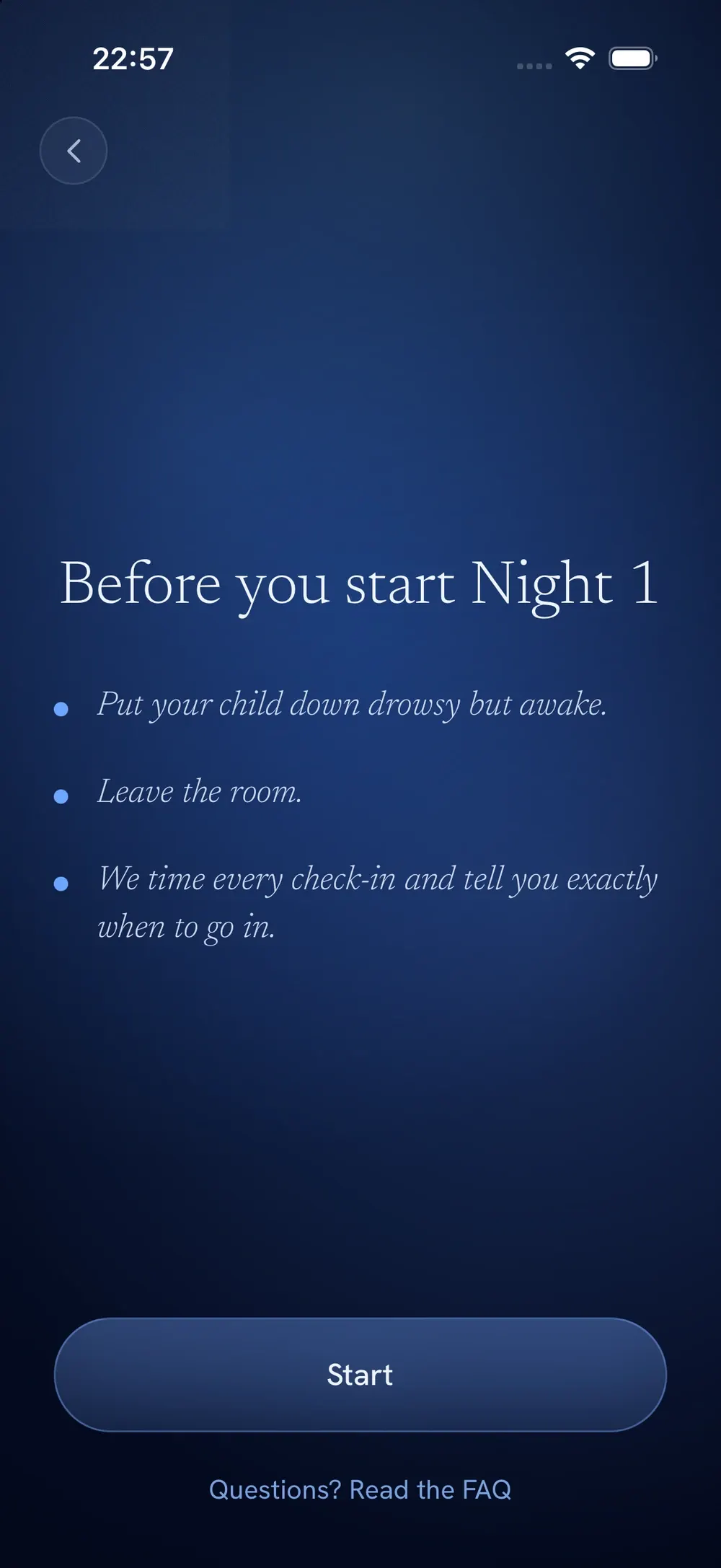
The Ferber app’s chart and night flow are built around a child sleeping in a crib: it runs each wait, alerts you at check-in time and restarts from the night’s first interval after a night waking. It is designed for babies around 6 months and older and won’t start a plan under 4 months.
Common questions
Is it too late to use the Ferber method at 18 months or 2 years?
No. Research on behavioral sleep treatments covers infants and young children, and the Sleep Foundation notes the Ferber method can be effective for toddlers when adapted to their developmental stage. Expect louder, more inventive protest, and plan for it.
What if my toddler climbs out of the crib?
Climbing out is a safety issue first. The American Academy of Pediatrics says to move a child to another bed when they are 35 inches tall or when the crib side rail is less than three-quarters of their height. Once in a bed, the method becomes calmly returning your child to bed.
How much sleep does a toddler need?
The American Academy of Sleep Medicine recommends 11 to 14 hours per 24 hours, including naps, for children 1 to 2 years old. Children vary within that range.
Should the check-ins be different for a toddler?
The shape is the same: brief, calm, boring. Toddlers understand more words, so a short, predictable phrase can help. Avoid negotiating, new requests or long conversations during a check-in.
Sources
- Sleep Foundation: The Ferber Method
- Mindell JA et al. Behavioral treatment of bedtime problems and night wakings in infants and young children. Sleep, 2006
- Paruthi S et al. Recommended amount of sleep for pediatric populations: AASM consensus statement. J Clin Sleep Med, 2016
- American Academy of Pediatrics (HealthyChildren.org): Make Baby's Room Safe, Parent Checklist
- American Academy of Pediatrics (HealthyChildren.org): Big Kid Beds, When to Switch From a Crib
- American Academy of Pediatrics (HealthyChildren.org): A Parent's Guide to Safe Sleep