Night wakings
Ferber and the pacifier: keep it, lose it, or replug it?
You can do the Ferber method with a pacifier. What the AAP says about pacifiers at sleep, and how to stop replugging it all night without taking it away.
You have lost count of how many times you have walked into the nursery tonight to find the pacifier, wipe it, and put it back. Your baby takes it, drifts off, it falls out, and forty minutes later you are back. You are ready to try the Ferber method, and you are wondering whether the pacifier has to go first.
It does not. You can do the Ferber method with a pacifier. The American Academy of Pediatrics recommends offering a pacifier at nap time and bedtime because it helps reduce the risk of SIDS, so taking it away is not the goal. What usually needs to change is the replugging: you finding and returning the pacifier every time your baby stirs. There are a few ways to handle that, and your pediatrician can help you pick one.
What the AAP says about pacifiers and sleep
The AAP’s safe sleep policy lists pacifier use among its recommendations for reducing the risk of SIDS (Moon et al., 2022). Its guide for parents puts it simply: try giving your baby a pacifier at nap time and bedtime, because pacifiers help reduce the risk of SIDS, even if the pacifier falls out after your baby is asleep.
A few details from the same AAP guidance matter for sleep training:
- If it falls out, you don’t have to put it back. The AAP says that if the pacifier falls out after your baby falls asleep, you don’t have to put it back in.
- Breastfed babies. If your baby is breastfed, the AAP suggests waiting until breastfeeding is established before offering a pacifier. Its pacifier page says this usually takes about 3 to 4 weeks, so by the age most families start the Ferber method, this has usually passed.
- No force. It is fine if your baby doesn’t want a pacifier. The AAP says not to force it.
- Not a meal replacement. The AAP says not to use a pacifier to replace or delay feeds.
The AAP’s pacifier page also names the problem this article is about. If your child depends on the pacifier to fall asleep, they may wake when it falls out, and if they are too young to put it back or can’t find it, you may need to get up and get it for them.
Why the pacifier can become a Ferber problem
The Ferber method works by helping your baby fall asleep in a way they can recreate on their own when they wake between sleep cycles. Anything your baby needs from you to fall asleep is a sleep association that has to be there again at 2 a.m.
A pacifier your baby can find and put in themselves is theirs. A pacifier that only goes in when you come and replug it is, in practice, a parent-dependent association, much like being rocked or fed to sleep. That is why a baby who falls asleep easily with a pacifier at bedtime can still wake every hour.
So the question is not “pacifier or no pacifier.” It is “who puts it back?”
The Ferber method with a pacifier: three approaches
Talk these over with your pediatrician, especially if your baby was born early, has any feeding or growth concern, or you are unsure how long to keep offering a pacifier at sleep.
1. Keep it, and let your baby learn to find it. Offer the pacifier as the last step of your bedtime routine, put your baby in the crib awake, and leave. If it falls out and your baby cries, you use the chart instead of going in to replug. Some babies learn to find and replace a pacifier themselves. During the day, you can practice by handing it to your baby and letting them put it in their own mouth, rather than doing it for them.
2. Offer it at bedtime, and replug only at check-ins. Some parents find a middle step easier. You still wait the chart’s intervals, and when you go in for a check-in, you can hand the pacifier back as part of the short visit, then leave. This keeps check-ins brief and predictable. The trade-off is that the check-in can start to feel like a replugging service, so some families use this for the first few nights and then move to the first approach.
3. Stop offering it. Some parents want to stop pacifier use altogether. Because the AAP recommends offering a pacifier at sleep to reduce SIDS risk, this is a decision to make with your pediatrician, not something to fold into a sleep-training week on your own. If your pediatrician agrees, change one thing at a time: settle the pacifier question first, then start the method, rather than taking away the pacifier on Night 1.
Whichever you choose, the rest of the method is the same. The waits grow each night, and a night waking starts again from that night’s first interval.
| Night | 1st wait | 2nd wait | 3rd wait, then every wait |
|---|---|---|---|
| Night 1 | 3 min | 5 min | 10 min |
Waits are in minutes. After the third wait, keep repeating the third value until your baby is asleep. If your baby wakes later in the night, start again from that night's first wait.
The full chart has every night, and check-ins explained covers how to keep each visit short and calm.
Pacifier safety in the crib
The AAP’s pacifier page also suggests a one-piece pacifier with a firm shield, replacing any that are torn or discolored, and never using a bottle nipple as a pacifier.
Pacifiers and night feeds
At 3 a.m., it can be tempting to offer the pacifier to buy a little time before a feed. The AAP says not to use a pacifier to replace or delay meals, and to offer it only when you are sure your baby is not hungry.
If your pediatrician wants a night feed kept, keep it, and use the pacifier and the chart for the other wakings. Our guide to night feeds and the Ferber method explains how to set a simple rule for which waking gets a feed. If your baby is around 6 months, the Ferber method at 6 months covers the other checks for that age.
If your baby seems unwell, is not feeding well, or is not gaining weight as expected, pause and talk to your pediatrician.
One thing to do tonight
Watch what happens after the pacifier falls out. Does your baby sleep on, fuss and find it, or cry until you come? That tells you which approach to start with. If they already find it some of the time, the first approach may be all you need.
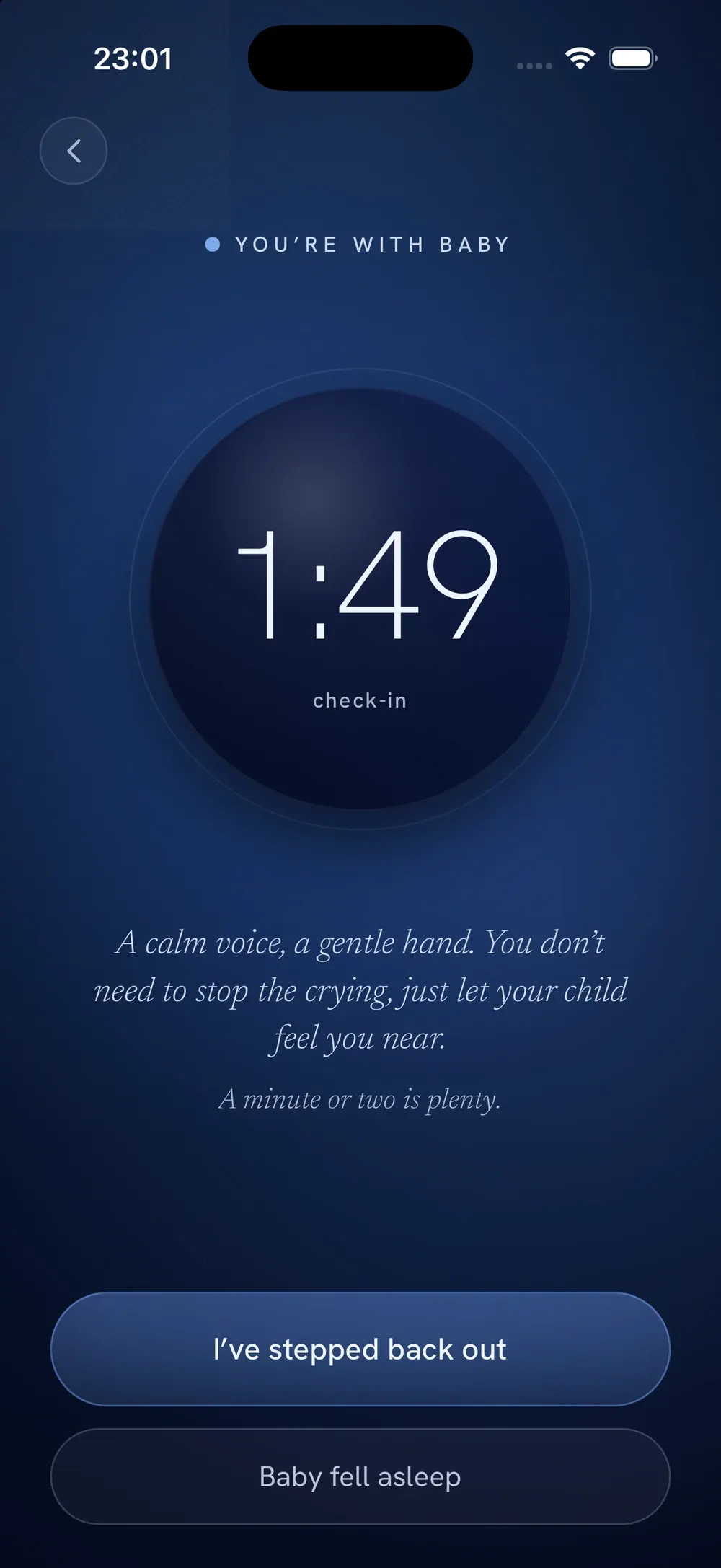
The Ferber app times every wait and check-in for you and restarts the chart after a night waking, so you can follow the plan you chose without watching the clock.
Common questions
Do I have to take the pacifier away to do the Ferber method?
No. The AAP recommends offering a pacifier at nap time and bedtime because it helps reduce the risk of SIDS. You can keep it and use the method to stop the cycle of replugging it through the night.
Should I put the pacifier back in when it falls out?
The AAP says that if the pacifier falls out after your baby falls asleep, you don't have to put it back in. During the Ferber method, some families offer it at bedtime and then stop replugging it at every waking, using the chart instead.
Can I use a pacifier clip in the crib?
No. The AAP says not to hang a pacifier around your baby's neck or attach it to their clothing when they are sleeping, and never to tie one to the crib.
Can I give the pacifier instead of a night feed?
The AAP says not to use a pacifier to replace or delay meals. Whether your baby still needs a night feed is a question for your pediatrician.
Sources
- American Academy of Pediatrics (HealthyChildren.org): A Parent's Guide to Safe Sleep
- American Academy of Pediatrics (HealthyChildren.org): Pacifiers and Thumb Sucking
- Moon RY et al. Sleep-related infant deaths: updated 2022 recommendations for reducing infant deaths in the sleep environment. Pediatrics, 2022
- American Academy of Pediatrics (HealthyChildren.org): How Often and How Much Should Your Baby Eat?
- American Academy of Pediatrics (HealthyChildren.org): Getting Your Baby to Sleep