Night wakings
What to do when your baby wakes at night during Ferber
During the Ferber method, a night waking gets the same plan as bedtime: restart from that night's first interval and check in briefly until your baby sleeps.
It is 2:40 a.m. Bedtime went better than you hoped, your baby fell asleep on their own after a couple of check-ins, and now they are crying again. You are half awake, standing in the hall, trying to remember what the plan says about this part.
Night wakings during the Ferber method get the same treatment as bedtime. If your baby is well and keeps crying, you wait that night’s first interval, do a short check-in, wait the next interval, and carry on until they fall back asleep. Every new waking starts again from the beginning of that night’s sequence. On Night 1, that means 3 minutes, then 5, then 10, with 10-minute waits repeating after that. The rest of this page covers the details that make 2 a.m. easier.
Why babies wake at night during Ferber
Waking in the night is normal. The American Academy of Pediatrics (AAP) notes that it is normal for a 6-month-old to wake during the night and go back to sleep after a few minutes. The difference is what happens next.
A baby who usually falls asleep being rocked, fed or held often needs that same help when they surface in the night, because the crib looks different from the place where they drifted off. The AAP puts it simply: if you hold babies or rock them to sleep, they may struggle to go back to sleep if they wake up during the night. That link between falling asleep and a particular kind of help is called a sleep association.
The Ferber method works on the way your baby falls asleep at bedtime, and it uses the same approach for each waking, so your baby gets one consistent message all night. If you want the full picture of how the method fits together, the method page explains it.
How to handle a night waking, step by step
- Give it a moment. The AAP advises not to rush in to soothe a crying baby, because babies need time to put themselves back to sleep. A short fuss often fades on its own.
- If the crying keeps going, start the night’s first interval. On Night 1 that is 3 minutes. On Night 4 it is 12.
- Check in briefly when the wait ends. Go in quietly, keep the lights off, say a few calm words, and perhaps pat your baby for a moment. The Sleep Foundation suggests keeping check-ins under one to two minutes and says not to pick your baby up or feed them during a check-in.
- Leave, even if they are still crying, and start the next interval.
- Keep repeating the last interval for that night until your baby falls asleep.
- If they wake again later, start over from that night’s first interval.
The Sleep Foundation describes this too: if a child falls asleep but wakes up later in the night, the intervals between check-ins can restart.
Here are the waits for every night of the week, in minutes. The third number repeats until your baby is asleep.
| Night | 1st wait | 2nd wait | 3rd wait, then every wait |
|---|---|---|---|
| Night 1 | 3 min | 5 min | 10 min |
| Night 2 | 5 min | 10 min | 12 min |
| Night 3 | 10 min | 12 min | 15 min |
| Night 4 | 12 min | 15 min | 17 min |
| Night 5 | 15 min | 17 min | 20 min |
| Night 6 | 17 min | 20 min | 25 min |
| Night 7 | 20 min | 25 min | 30 min |
Waits are in minutes. After the third wait, keep repeating the third value until your baby is asleep. If your baby wakes later in the night, start again from that night's first wait.
Our Ferber method chart explains how to read it, and what to do during a check-in covers the visit itself in more detail.
What counts as a new waking
This is the question that trips up most parents at night. A new waking is when your baby has fallen asleep and then wakes and cries again. That one restarts from the night’s first interval.
A pause is different. Sometimes a baby goes quiet for a minute, then starts crying again without ever falling asleep. Decide before Night 1 how you will treat a short pause like that, write it down, and use the same rule every night of the week. Consistency matters more here than which rule you pick.
Fussing, babbling and rolling around are also fine. The waits are for crying. If your baby is grumbling quietly or talking to themselves, there is no need to go in or start a timer.
Night feeds, diapers and other reasons to go in
Some wakings need you for a practical reason, and handling them does not undo the plan. The AAP notes that you can still attend to your baby, such as feeding them, changing a dirty diaper or comforting them if they are sick.
Night feeds. Whether your baby still needs a night feed is a question for your pediatrician. If they want a feed kept, decide in daylight which waking gets it (for example, the first waking after a set time) and use the intervals for the rest. After the feed, put your baby back in their crib, on their back, and if they cry, start that night’s first interval.
Dirty diapers. Keep it dim and boring. The AAP suggests staying calm and quiet at night and trying not to stimulate your baby when you feed or change them. Change the diaper, put your baby back down on their back, and restart the wait if they are still crying.
Safe sleep after every waking. Whatever happened, your baby goes back on their back, on a firm, flat surface in their own crib, with no pillows, blankets, bumpers or soft toys. The AAP recommends sharing a room without sharing a bed for at least the first 6 months. The AAP safe sleep guide has the details.
If you suspect teething or a cold is behind a run of bad nights, the guide to teething and illness covers when to pause and how to pick back up.
What to expect from night wakings over the week
Night wakings often take a few nights to change, and Nights 2 and 3 can feel harder than Night 1. Our article on why Night 2 or 3 can be worse explains why that happens.
The research is encouraging, with the usual caveats. In a randomized trial of 43 infants aged 6 to 16 months, graduated extinction (the research term for the Ferber method) led to large decreases in the number of awakenings compared with a control group given sleep education. An American Academy of Sleep Medicine review of 52 studies found that 94% reported behavioral treatments for bedtime problems and night wakings were effective, and it found support for graduated extinction. These are averages across groups of children, and no study can tell you which night your own baby will sleep through.
The Sleep Foundation says many families see progress within three to seven nights, and suggests talking to your pediatrician or a sleep specialist if there is no improvement within a week. If your baby wakes three or four times a night, the page on multiple night wakings walks through the checks to run. Very early wakings have their own guide: early-morning wakings.
Before you go to bed tonight
Agree on two things with anyone else who might get up in the night: what counts as a new waking, and which waking (if any) gets a feed your pediatrician wants kept. Write both on a sticky note by the crib. It is much easier to follow a decision made at 7 p.m. than to make one at 3 a.m. The guide to co-parenting and consistency helps if you see it differently.
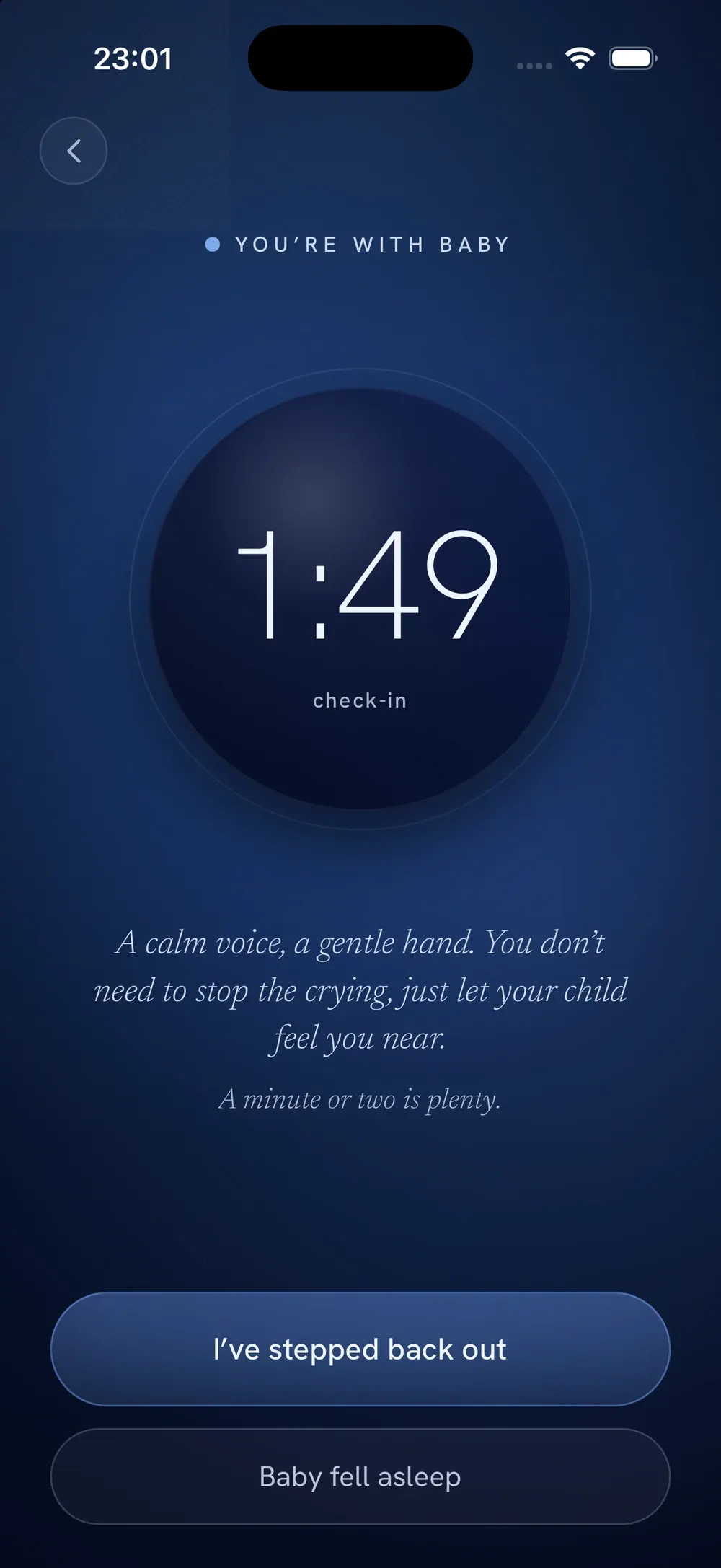
When you tell the Ferber app your baby has woken up, it restarts from that night’s first interval, runs each countdown, and times the check-in (2 minutes by default), so you do not have to remember where you are in the middle of the night.
Common questions
Do the Ferber intervals restart when my baby wakes in the night?
Yes. With the Ferber method, each new night waking starts again from that night's first interval. On Night 1 that means waiting 3 minutes, then 5, then 10, with 10-minute waits repeating until your baby falls back asleep.
Should I go in straight away when my baby wakes at night during Ferber?
Usually not. Babies often fuss for a moment and settle again on their own. If the crying continues, start that night's first interval, and only go in for a check-in if your baby is still crying when the wait ends.
Can I feed my baby during a night waking while doing Ferber?
Whether your baby still needs a night feed is a question for your pediatrician. If they want a feed kept, keep it on a clear rule decided in advance, and use the Ferber intervals for the other wakings.
When should I stop the Ferber method at night and comfort my baby?
Stop and comfort your baby if they vomit, have a fever, have trouble breathing, seem unusually drowsy, or cry in a way that sounds like pain. Pause the plan and call your pediatrician if you are worried. You can start again once your baby is well.
Sources
- Sleep Foundation: The Ferber Method
- American Academy of Pediatrics (HealthyChildren.org): Getting Your Baby to Sleep
- American Academy of Pediatrics (HealthyChildren.org): A Parent's Guide to Safe Sleep
- Gradisar M et al. Behavioral interventions for infant sleep problems: a randomized controlled trial. Pediatrics, 2016
- Mindell JA et al. Behavioral treatment of bedtime problems and night wakings in infants and young children. Sleep, 2006