Intervals and check-ins
How long do you let a baby cry with the Ferber method?
With the Ferber method you wait a set interval, then check in briefly. Night 1 starts at 3, 5 and 10 minutes, and the waits grow a little each night.
You have read about the Ferber method, you think you are ready, and one question keeps coming back: how long am I actually supposed to let my baby cry? Nobody wants to stand outside the door with no idea when they are allowed back in.
With the Ferber method, you let your baby cry for a set, short interval, then go in for a brief check-in, then wait a slightly longer interval, and so on. On Night 1 of the chart the Ferber app uses, the waits are 3 minutes, then 5, then 10, with 10-minute waits repeating until your baby falls asleep. Each night the waits grow a little, up to 20, 25 and 30 minutes on Night 7. You are never asked to leave your baby without a visit for longer than that night’s longest interval.
How long to let a baby cry with the Ferber method, night by night
Dr. Richard Ferber described graduated waits in his book Solve Your Child’s Sleep Problems, first published in 1985 and revised in 2006. The Sleep Foundation notes that he gives exact intervals in the book and also says they can be slightly modified to fit caregivers’ needs.
The Ferber app uses the chart below. Each row is one night. The first number is the wait before your first check-in, the second is the wait before your second check-in, and the third repeats for every check-in after that until your baby is asleep.
| Night | 1st wait | 2nd wait | 3rd wait, then every wait |
|---|---|---|---|
| Night 1 | 3 min | 5 min | 10 min |
| Night 2 | 5 min | 10 min | 12 min |
| Night 3 | 10 min | 12 min | 15 min |
| Night 4 | 12 min | 15 min | 17 min |
| Night 5 | 15 min | 17 min | 20 min |
| Night 6 | 17 min | 20 min | 25 min |
| Night 7 | 20 min | 25 min | 30 min |
Waits are in minutes. After the third wait, keep repeating the third value until your baby is asleep. If your baby wakes later in the night, start again from that night's first wait.
So on Night 1, if your baby is still crying, you would check in at 3 minutes, again 5 minutes after you leave, and then every 10 minutes. On Night 3 the waits are 10, 12, then 15. The Ferber method chart explains why the waits get longer and how to read each row.
The check-in itself is short. The Sleep Foundation suggests keeping it under one to two minutes, with a pat or a soft voice, and without picking your baby up or feeding them. The Cleveland Clinic describes the same idea: you can shush or talk quietly to offer comfort. Our page on what to do during a check-in covers what to say and how to leave.
The timer only runs while your baby is crying
The interval measures crying. If your baby goes quiet before the timer ends, you do not go in. If they are fussing, babbling or rolling around, that is fine too, and there is nothing to time.
If your baby falls asleep and later wakes up crying, the waits start again from that night’s first interval. The Sleep Foundation describes this restart for night wakings. Our article on night wakings during Ferber goes through it step by step, including what to count as a new waking.
It also helps to know that the total time your baby cries is not something the chart controls. Some babies fall asleep after one check-in. Others cry through several rounds of the longest wait before they settle. Both are within the normal range, and neither tells you the method is failing.
Can you shorten the waits?
Yes. The Sleep Foundation notes that some parents modify the method by adjusting the check-in intervals and offering more frequent reassurance. If the Night 1 waits feel like too much, you could start with shorter ones.
Two things make a change work better:
- Decide before bedtime. Pick your waits in the afternoon and use them all night. Shortening the waits in the moment because the crying got louder can teach your baby that louder crying brings you back sooner.
- Keep the pattern of growing waits. The waits get longer over the week so that your baby gets a little more practice falling asleep without you each night.
If you are weighing a gentler approach altogether, our comparison of Ferber, cry it out and the chair method sets them side by side. The compare page has a shorter summary.
What if the crying goes on for a long time?
Keep going in at each interval, for as long as the crying lasts. That is the part that separates the Ferber method from cry it out, where parents do not go in at all. You are allowed to check on your baby every single time the timer ends.
Long crying spells are most common in the first few nights, and Nights 2 and 3 are often harder than Night 1. Our article on why Night 2 or 3 can be worse explains what is going on. The Sleep Foundation says many families see progress within three to seven nights and suggests talking to your pediatrician or a sleep specialist if there is no improvement after a week.
The research behind the method is reasonably strong. An American Academy of Sleep Medicine review of 52 studies found that 94% reported behavioral treatments for bedtime problems and night wakings were effective, with support for graduated extinction, the research name for this approach. In a trial of 156 mothers of babies aged 6 to 12 months, more sleep problems had resolved at two months in the group taught controlled crying than in the comparison group, though by four months the two groups were similar. Results like these describe groups, so they cannot promise how long your own baby will cry.
When crying means something else
The waits are meant for a healthy baby protesting a change. A baby who is unwell, hurt or frightened by something real needs comfort instead.
If you are not sure, go in and look. Checking on a baby you are worried about is always fine. When you put your baby back down, place them on their back, in their own crib, on a firm, flat surface with no pillows, blankets, bumpers or soft toys. The AAP safe sleep guide has the full guidance.
If listening to the crying is the hard part
For a lot of parents, the waits are harder on them than the numbers suggest. Three minutes can feel like twenty when it is your baby. That reaction is normal, and it does not mean you are doing something wrong.
Some parents find it easier to sit somewhere they can see the timer and do something with their hands. Others take turns, so one adult does a whole night. If it feels like too much, you can shorten the waits, pause, choose a different method, or decide not to sleep train at all. Our page on when you cannot listen to your baby cry has more ideas. And if you are feeling low or overwhelmed most days, please mention it to your own doctor.
Before bedtime tonight
Look at tonight’s row in the chart and write the three numbers somewhere you will see them in the dark. If you plan to shorten the waits, write down your own numbers instead, and agree on them with anyone else doing check-ins.
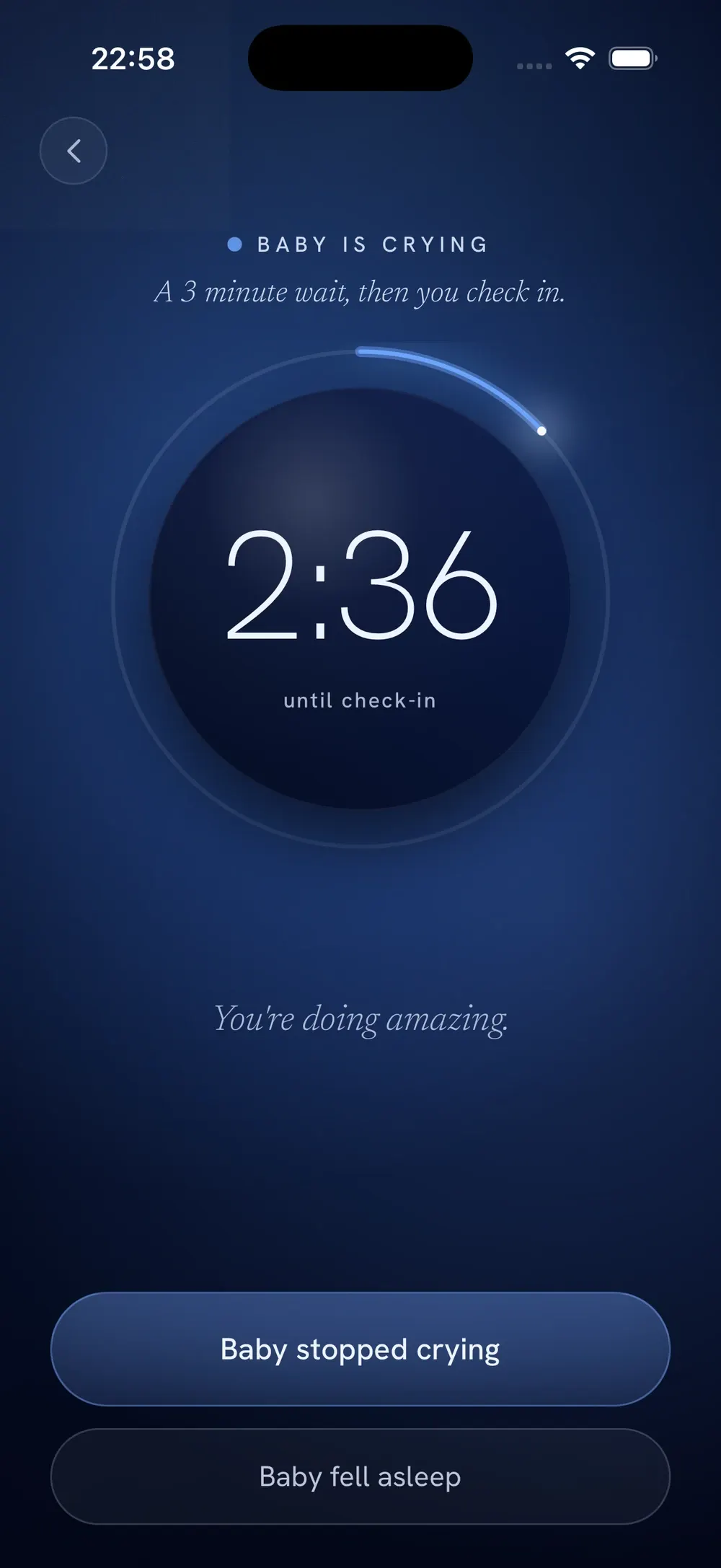
The Ferber app runs every countdown for you, alerts you when it is time to check in, and times the check-in (2 minutes by default), so you never have to watch the clock while your baby cries.
Common questions
How long do you let a baby cry on the first night of Ferber?
On Night 1 of the chart the Ferber app uses, you wait 3 minutes before the first check-in, 5 minutes before the second, and 10 minutes before the third and every check-in after that, until your baby falls asleep. Each check-in is brief, under one to two minutes.
Is there a maximum time to let a baby cry with the Ferber method?
The Ferber method does not leave a baby to cry without a visit. You check in briefly every time a wait ends, for as long as the crying continues. If something about the crying worries you, or your baby seems unwell, stop and comfort them and call your pediatrician if needed.
Can I make the Ferber intervals shorter?
Yes. The Sleep Foundation notes that the intervals can be modified to fit caregivers' needs, and some parents offer more frequent reassurance. Choose your waits before bedtime and use them all night, rather than changing them in the middle of a crying spell.
Do I start the timer again if my baby stops crying?
The waits are for crying. If your baby stops crying before a wait ends, you do not go in. If they fall asleep and later wake and cry, start again from that night's first interval.
Sources
- Sleep Foundation: The Ferber Method
- Cleveland Clinic: What Is the Ferber Method?
- Solve Your Child's Sleep Problems, revised edition (Richard Ferber, 2006)
- Mindell JA et al. Behavioral treatment of bedtime problems and night wakings in infants and young children. Sleep, 2006
- Hiscock H, Wake M. Randomised controlled trial of behavioural infant sleep intervention to improve infant sleep and maternal mood. BMJ, 2002
- American Academy of Pediatrics (HealthyChildren.org): A Parent's Guide to Safe Sleep